
Eyes on the road – are eyesight and cognitive tests for drivers over 70 fair, effective or practical?
15 Aug, 2025
Emily Evans, ILC’s Senior Communications and Engagement Manager, reflects on the latest Government proposals to overhaul road safety and the future of driving in an ageing society – and revisits previous ILC research on driving in later life.
In summary
This blog reviews potential proposals for mandatory eyesight testing every three years for drivers aged 70+, with possible cognitive screening where dementia is suspected. It concludes that while age-related changes in vision can affect driving, the evidence base for blanket age-based testing is patchy.
The existing rates of serious injuries and deaths per mile in vehicle accidents do rise after 70 – particularly after 80. However, older drivers often have lower crash rates per licence holder than younger drivers, and the absolute number of serious casualties involving older drivers remains below other age groups. Data attributing some incidents to sight problems exist, but the numbers are small, and evidence on dementia’s specific impact on driving capacity is limited.
The blog also looks at existing requirements in other countries. In addition, it flags risks around deliverability, rural access, affordability and potential insurance consequences, and argues for proportionate, outcome-focused measures that protect mobility for older people.
Previous ILC research recommends:
• Pilot targeted, evidence-based screening rather than blanket testing
• Make compliance easy and fair
• Support safe driving without unfair assumptions or stigma
In short, measures that prevent serious injury or death are – of course – to be welcomed but starting at any specific age without robust evidence is arbitrary.
The rationale behind the proposals
It has been widely reported that the Government’s latest road safety proposals, due to be published later this year, might include mandatory eyesight tests for drivers aged 70 and over every three years – and potential cognitive screening where dementia is suspected. This is reportedly in response to growing public concern about the role of age-related sensory and cognitive changes in road safety, as well as the rising number of older drivers on Britain’s roads. The proposals will form part of a wider road safety strategy designed to reduce the number of vehicle deaths, which have plateaued in recent years.
But any policy must be designed to improve safety without unnecessarily curtailing older people’s mobility. For many, driving is not simply a convenience – it is a lifeline, supporting social connection, access to services and a sense of independence. Poorly implemented, testing could unintentionally increase isolation and worsen health inequalities.
What the evidence tells us
ILC’s A fork in the road (2020) found that extending driving lifespans is linked to better wellbeing – provided driving remains safe. Yet age-related changes in vision, such as reduced contrast sensitivity, slower adaptation to glare and narrower visual fields, can undermine safe driving, especially at night or in poor weather.
The Department for Transport’s (DfT) latest factsheet on older drivers shows that since 2004 killed or seriously injured (KSI) casualties from collisions involving at least one car driver aged 70+ increased modestly from 3,082 to 3,451 in 2023. KSI casualty rates per billion miles driven increase from 18.8 for drivers aged 60–69 to 56.7 for those aged 70+, and fatal crash risk per mile rises steeply after age 80.
Our analysis of data between 2014 and 2023 shows that fatalities and serious injuries involving drivers aged 70 and over have increased slightly over the last decade (compared with decreases among other age groups). However, as the chart below shows, the number of serious casualties involving older drivers remains significantly below that for other age groups.

While drivers aged 70–79 often have lower crash rates per licence holder than younger drivers, their relative physical fragility means crashes involving older people – whether as drivers, passengers or pedestrians – are more likely to result in serious injury or death than for younger age groups.

DfT research also found that 42 per cent of incidents involving drivers over 70 were due to sight problems. However, the absolute numbers remain low.
While certain forms of dementia may affect visual perception and cognitive ability – potentially years before diagnosis – there is even less evidence about how dementia specifically affects driving capacity.
ILC’s Driving in later life: options for reform (2011) recommends a proportionate approach – encouraging self-declaration of relevant conditions, backed by public awareness campaigns, and introducing cognitive screening only where concerns arise, rather than blanket mandatory testing by age. This avoids stigmatising safe drivers while still identifying those genuinely at risk.
How many people could be affected?
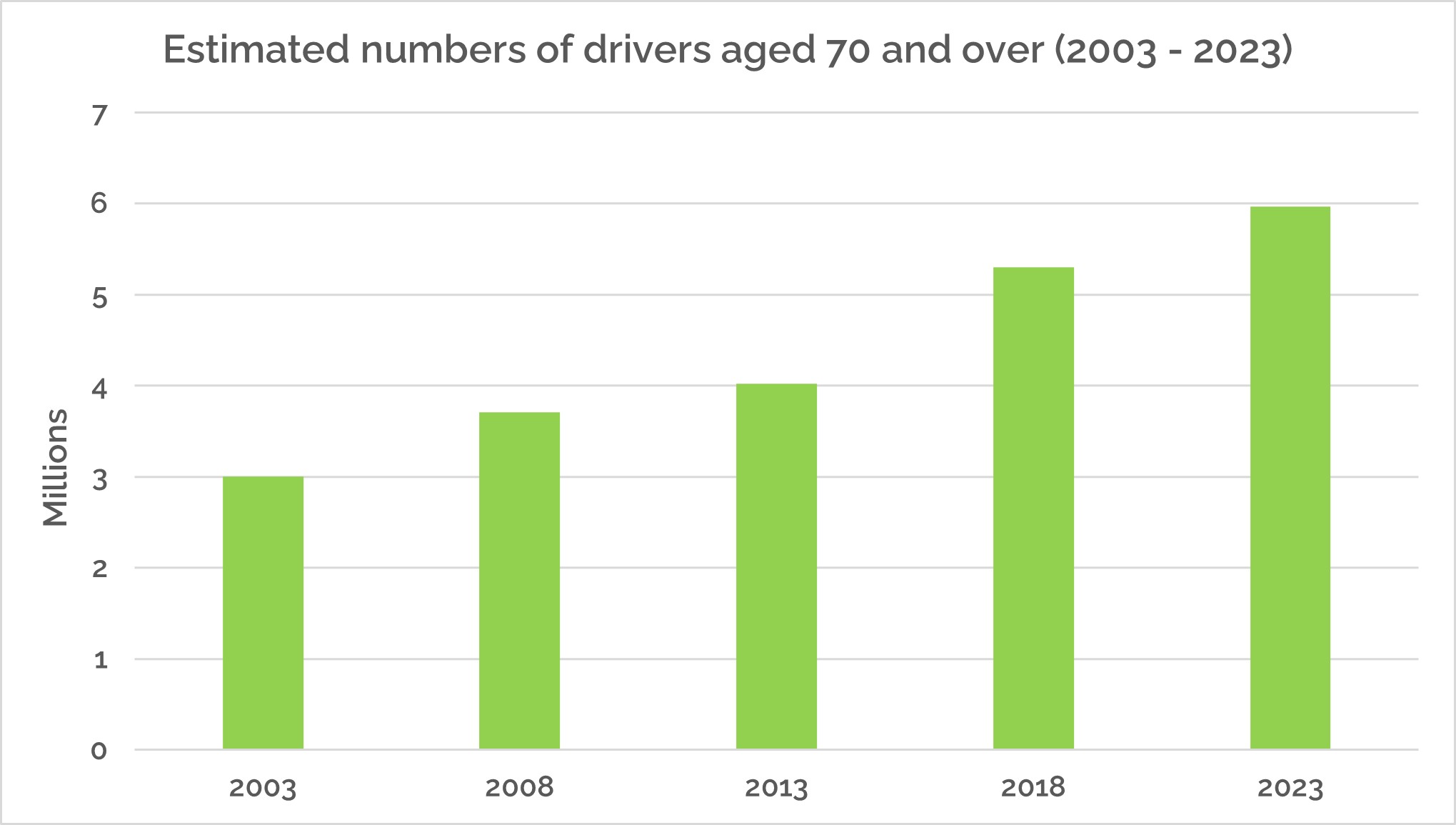
Licence holding in later life has doubled over the last two decades. In Great Britain, there were about 5.97 million full driving licence holders aged 70 and over in 2023 (including around 1.65 million aged 80+). This compares with an estimated 2.8 to 3.0 million in 2003.
What should the testing look like?
When you take your driving test in the UK, the minimum requirement is that a driver can read a number plate from 20 m – approximately the length of two double-decker buses – which equates to binocular visual acuity of at least 0.5 (6/12 Snellen). Licences in the UK must be renewed and the photograph updated every 10 years until age 70, after which renewal is every three years – but visual acuity is not routinely retested after the initial driving test.
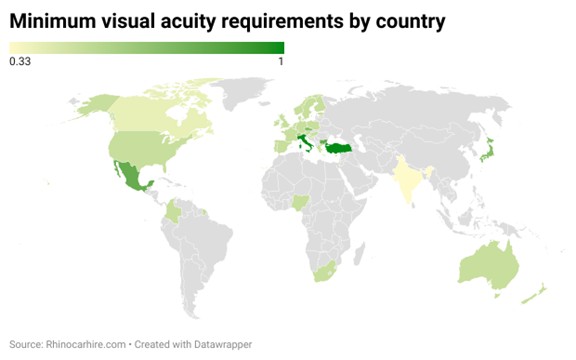
As in the UK, and under the EU Directive (2006/126/EC), all European countries require binocular visual acuity of at least 0.5, but in many European countries requirements are more stringent. Italy and Turkey, for example, require 20/20 vision (6/6 on the Snellen chart), and medical certificates are required after each renewal.
| Country | Requirements |
| Slovenia | Drivers without limited validity due to health reasons must attach a medical certificate when renewing after age 70 (or 80 if licensed under old law). |
| Austria | Renewal every 15 years, no medical examination required. Ophthalmic problems at first check-up mean shorter validity and medical examination at each renewal. |
| Germany | Licenses extended to 15 years, no medical examination unless required by medical certificate time limit. |
| Switzerland | License valid for 3 years from age 18; if no issues, valid until age 75. After 75, renewal and medical exam every 2 years. |
| France | Renewal every 15 years without medical examination unless issues arise. Vision test required after an accident. |
| The Netherlands | Renew every 10 years; after age 70 every 5 years with medical examination required every 5 years after age 75. |
| Denmark | Renew every 15 years; over 70–71 every 4 years; 72 every 3 years; 72–79 every 2 years; over 80 every year. Medical certificate required after age 75. |
| United Kingdom | Renew every 10 years; after 70 every 3 years without mandatory medical exam unless issues arise. Declaration of fitness required. |
| Iceland | After 65, physician must certify vision at renewal; after 72 every 2 years; after 80 every year. |
| Norway | After 75, physician must certify vision at renewal; after 78 every 2 years. |
| Sweden | No requirements. |
| Hungary | License valid for 10 years until age 50; 5 years between 50–60; 3 years between 60–70; 2 years after 70. Medical examination always required. |
| Italy | Renew every 10 years; after 50 every 5 years; after 70 every 3 years; after 80 every 2 years. Medical certificate required for each renewal. |
Source: Kobal N, Hawlina M. Comparison of driving licence renewal requirements in different European countries as of September 2022.
Outside Europe, requirements are generally less stringent. Canada has a relatively low threshold of 0.4 (20/50) on the Snellen chart, with India the lowest of those recorded at 0.33 (6/18).
The ILC would hope that any changes to licence renewal requirements in the UK are outcome-focused, proportionate and accessible. Simple visual-acuity checks alone (for example, the 6/12 Snellen standard and the 20-metre number-plate test) are necessary but probably not sufficient. A practical scheme should:
- Use evidence-based tests that reflect real-world driving demands, including visual fields and contrast sensitivity, not just high-contrast acuity
- Allow drivers to meet the standard with spectacles or contact lenses, and signpost rapid correction where needed
- Offer convenient routes to compliance: online booking and digital certification, with options for in-person and domiciliary testing for those who need it
- Provide clear, appealable pathways for drivers who fail – linking to timely treatment, new prescriptions or restricted licences where appropriate
Internationally, many countries already require periodic vision screening at renewal from age 70 or earlier. In Panama, for example, drivers take vision and hearing tests at renewal (with online options), and those aged 70+ renew more frequently and need a brief medical certificate; people aged 85+ must also undertake a short on-road skills check.
Another ILC report published in 2011, Can older drivers be nudged?, adds that behavioural nudges – such as personalised risk feedback, voluntary refresher courses and on-road assessments – can help drivers reflect honestly on their abilities and adapt their driving, often more effectively than punitive measures. And a subsequent think piece for the ILC in 2011 by Dr Charles Musselwhite suggested approaches that help older people avoid the negative or adverse effects of giving up driving.
Dr Musselwhite, Senior Lecturer in Traffic & Transport Psychology at the University of the West of England, Bristol wrote, “Older people need to be mobile for a variety of reasons. These include accessing daily services and shops and remaining connected to friends, family and other social events. Yet travel goes beyond that, it is a way of maintaining independence, of conveying status and image and an access to life beyond the home, a way of engaging with nature and seeing the world.”
Capacity and delivery: can the system cope?
Another potential issue is the capacity to deliver the additional eye tests required. Capacity exists in principle, but delivery detail matters. England alone sees roughly 13 million NHS sight tests a year through ophthalmic services, with total NHS and private sight tests estimated at around 20 million annually. As of March 2024, the UK optical workforce included just over 18,000 registered optometrists (and over 30,000 optical registrants in total).
If around six million drivers aged 70+ are tested in person on a three-year cycle, the steady-state demand is roughly two million tests a year – in theory, well within overall capacity, provided commissioning, funding and access are addressed. The bigger risks are uneven coverage (especially in rural areas), affordability for people on low incomes, and digital exclusion.
To succeed, the Government should fund a simple, nationally accepted certificate (issued by optometrists and uploaded to DVLA), guarantee digital options, and avoid creating bottlenecks in peak renewal periods.
Unintended consequences and insurance
Testing could influence insurance markets in two ways. If results are shared, insurers may view older drivers as higher risk and raise premiums, even for those who pass. This could make driving unaffordable for some.
However, insurers could reward drivers who pass with lower premiums, similar to how telematics data are used for younger drivers. This would require:
- Driver-owned data, with consent for sharing
- Pass/fail information only, without detailed medical disclosure
- Collaboration between DVLA, the insurance industry and regulators to ensure fairness and avoid discrimination
Without these safeguards, reform could unintentionally penalise safe, competent older drivers.
The benefits without the downsides
It would be difficult to argue against measures that demonstrably improve safety while protecting mobility in later life. A robust, inclusive system should:
- Use evidence-based measures – for example, including visual field tests and contrast sensitivity alongside acuity – and allow for correction with glasses or contact lenses
- Incorporate proportionate cognitive screening only where there is a clinical indication or credible concern
- Provide multiple testing routes: in-person at opticians, mobile visits for housebound drivers, and digital options for those able to use them
- Offer clear referral and re-testing pathways for those who fail, including access to treatment or corrective measures
- Include rural-friendly provisions so drivers without nearby opticians are not disadvantaged
Done well, eyesight screening can reduce harm without curtailing independence. Done badly, it could strand older drivers – especially those in rural areas – without meaningfully improving safety. The policy’s success will hinge on the test standard, delivery model and support for people who need correction or treatment.
End notes
Government proposal for mandatory eyesight tests for drivers aged 70+ (news coverage, Aug 2025). https://www.theguardian.com/uk-news/2025/aug/11/uk-ministers-urged-do-more-protect-new-drivers-road-safety-overhaul
Further report on the planned road safety strategy and over‑70 eyesight testing. https://www.thetimes.co.uk/article/driving-reforms-over-70-eye-tests-drink-drive-reduction-gph5rvjw0
ILC: A fork in the road: the future of driving in an ageing society. (February 2020) https://ilcuk.org.uk/a-fork-in-the-road-the-future-of-driving-in-an-ageing-society/
ILC: Driving in later life: options for reform. (November 2011) https://ilcuk.org.uk/driving-in-later-life-options-for-reform/
ILC: Can older drivers be nudged? (February 2011) https://ilcuk.org.uk/can-older-drivers-be-nudged/ and ILC: Successfully giving up driving for older people. (November 2011) https://ilcuk.org.uk/successfully-giving-up-driving-for-older-people/
DfT: Reported road casualties in Great Britain – older driver factsheet (2023 data, published 26 Sept 2024). https://www.gov.uk/government/statistics/reported-road-casualties-great-britain-older-and-younger-driver-factsheets-2023/reported-road-casualties-in-great-britain-older-driver-factsheet-2023
Road safety statistics: data tables (updated 31 July 2025) Road safety statistics: data tables - GOV.UK
DVLA/DFT: Driving licence data (GB), May 2025 dataset and series landing page. https://www.data.gov.uk/dataset/d0be1ed2-9907-4ec4-b552-c048f6aec16a/driving-licence-data
RAC Foundation summary: older licence holders (context for 5.97m aged 70+ in 2023). https://www.racfoundation.org
RoSPA: Older drivers – Road Safety Observatory review (KSI per billion miles rises sharply after 70). https://www.rospa.com/siteassets/images/road-safety/road-safety-projects/road-safety-observatory/drivers-older-drivers.pdf
College of Optometrists: Position on vision standards for driving (6/12 Snellen and adequate visual fields). https://www.college-optometrists.org/policy-and-influencing/position-statements/position-on-vision-standards-for-driving
GOS activity: ~13 million NHS sight tests in England 2022–23 (peer‑reviewed analysis) and NHSBSA data hub. https://pubmed.ncbi.nlm.nih.gov/39377878/
FODO policymaker briefing – c.19.6 million sight tests annually in England (NHS + private). https://www.fodo.com/policymakers/eye-care-services/england/
Workforce context: ~18,000 GOC‑registered optometrists (Docet/College year‑end 2023–24). https://docet.info/pluginfile.php/55980/mod_page/content/38/DOCET%20Yr%20End%20Rpt%202023-24_final.pdf
Kobal N, Hawlina M. Comparison of visual requirements and regulations for obtaining a driving license in different European countries and some open questions on their adequacy. Front Hum Neurosci. (September 2022) https://pmc.ncbi.nlm.nih.gov/articles/PMC9561926/#S3
Rhinocarehire.com Eyesight Regulations for Driving – Is Wearing Glasses Mandatory? https://www.rhinocarhire.com/Drive-Smart-Blog/Driving-Eyesight-Standard-by-Country.aspx
Panama licence renewal: official contractor (Sertracen) renewal page and requirements. https://www.sertracen.com.pa/en/renovacion/
Panama practice: renewal intervals and vision/hearing test; over‑70 requirements. https://panamarelocationtours.com/drivers-license-requirements-in-panama
Emily Evans
Senior Communications and Engagement Manager
Emily is the Senior Communications and Engagement Manager at ILC-UK and joined at the end of April 2022 having spent over 25 years working in public affairs, communications and public sector policy analysis. She works across all ILC’s projects, events and communications and produces the ILC’s weekly Friday three newsletter.
After six years of living and working in a remote area of Panama, she returned to the UK with her family in August 2021. While in Panama she worked as an English teacher in various rural primary schools and for a parliamentary monitoring company, reporting on Select Committee evidence sessions, and gaining comprehensive policy knowledge on everything from social care to biosecurity. On her return to the UK worked as a Content Manager for a new cycle-to-work scheme provider specializing in e-bikes.
Following an interesting but not particularly employable zoology degree at Bristol University, Emily trained as a primary teacher and taught in various London schools. She worked for many years for a teachers’ union, first on education policy and then as the union’s Parliamentary and Campaigns Officer. Emily has also done assorted jobs at several small charities in Panama and the UK.
As a child, she moved from Nigeria to New Zealand and many places in between. She is happiest in a muddy field at a music festival or at the Emirates Stadium but also enjoys running, cycling and travelling. Emily lives in Central London with her partner and two teenage daughters.