
How life expectancy has improved in the birthplaces of England and Wales’ women’s teams
27 Jul, 2025
Emily Evans, ILC’s Senior Communications and Engagement Manager, takes a quick look at life expectancy in the birthplaces of the English and Welsh women’s football players – showing how gains in life expectancy at birth have stalled over time. The analysis also highlights a stark regional contrast: a girl born in Richmond upon Thames, where Lauren James grew up, can still expect to live, on average, nearly seven years longer than a girl born in Grace Clinton’s hometown of Liverpool.
Since the birth of the women selected to play for England and Wales in this summer’s UEFA Euros, female life expectancy has increased. At the time these footballers were born, such gains were anticipated – driven by medical advances, improved technology and rising living standards.
However, as the chart below shows, the extent of improvement varies significantly by location. In some places – such as Cardiff, where Jess Fishlock was born, or Richmond upon Thames, where Lauren James was born and raised – increases in period life expectancy over time have been much more pronounced.
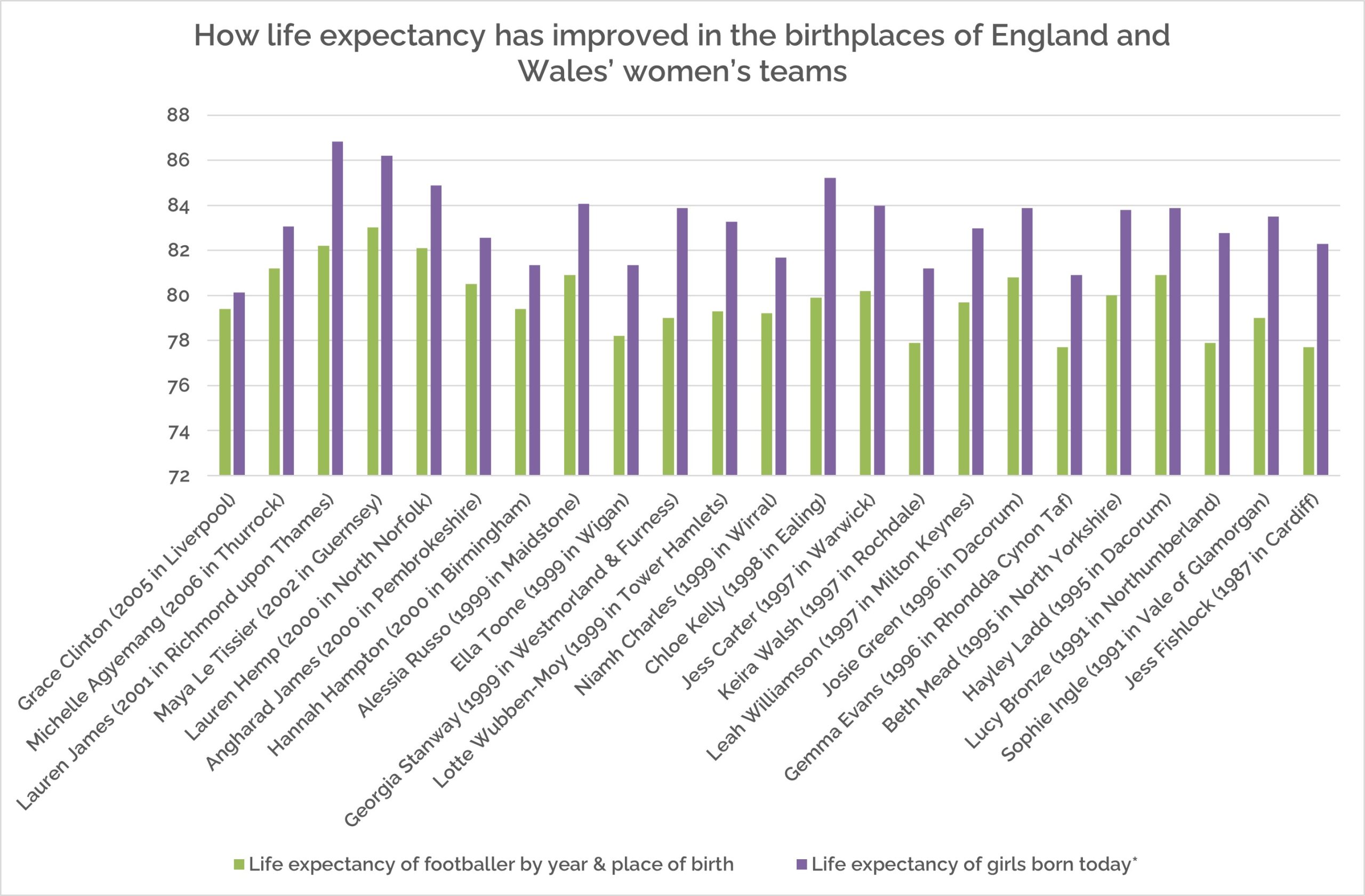 *Latest ONS life expectancy data (2021 to 2023)
In recent years, however, improvements in period life expectancy have stalled – as the table below illustrates. This helps to explain why the increases are more marked for some of the older players than for the younger ones.
| Average female life expectancy in England and Wales | |||
| Benchmark year | Life expectancy at birth in benchmark year (years) | Life expectancy 2021–23 (years) | Improvement since benchmark year (years) |
| 1985 | 77.8 | 82.8 | 5 |
| 1990 | 78.8 | 82.8 | 4 |
| 1995 | 79.5 | 82.8 | 3.3 |
| 2000 | 80.6 | 82.8 | 2.2 |
| 2005 | 81.7 | 82.8 | 1.1 |
But what the data also shows is that, even today – despite every medical advance – a girl born in Richmond upon Thames can still expect to live, on average, nearly seven years longer than a girl born in Grace Clinton’s hometown of Liverpool.
To help explain why in 2025 such inequalities still exist, the ILC is developing a UK Better Lives Index to explore how well different areas across the UK support their populations to live longer, better lives. It will identify the best and worst groups of places to be born, grow up and grow old in, and outline what needs to happen now to deliver better lives for all people and places. The project is supported by Edwards Lifesciences, Hallmark Foundation and Pfizer.
For more information please see here and if you would like to get involved in the project please email us at info@ilcuk.org.uk
Notes and sources
- Wikipedia biographies of the football players selected to play for the English and Welsh teams at the UFEA Euros 2025
- Life Expectancy at Birth and at Age 65, by Local Areas in England and Wales, 1991–93 to 2012–14 ONS dataset here
- Latest ONS life expectancy data (2021 to 2023) - ILC UK Better Lives Index
- *Guernsey data from the CIA World Factbooks 2002 and 2023
- *Unable to find ONS life expectancy data by local authority pre-1991 so 77.7 is an estimate based on average female life expectancy at birth in Wales which fell between 77.53 and 77.88 years at the time.
Emily Evans
Senior Communications and Engagement Manager
Emily is the Senior Communications and Engagement Manager at ILC-UK and joined at the end of April 2022 having spent over 25 years working in public affairs, communications and public sector policy analysis. She works across all ILC’s projects, events and communications and produces the ILC’s weekly Friday three newsletter.
After six years of living and working in a remote area of Panama, she returned to the UK with her family in August 2021. While in Panama she worked as an English teacher in various rural primary schools and for a parliamentary monitoring company, reporting on Select Committee evidence sessions, and gaining comprehensive policy knowledge on everything from social care to biosecurity. On her return to the UK worked as a Content Manager for a new cycle-to-work scheme provider specializing in e-bikes.
Following an interesting but not particularly employable zoology degree at Bristol University, Emily trained as a primary teacher and taught in various London schools. She worked for many years for a teachers’ union, first on education policy and then as the union’s Parliamentary and Campaigns Officer. Emily has also done assorted jobs at several small charities in Panama and the UK.
As a child, she moved from Nigeria to New Zealand and many places in between. She is happiest in a muddy field at a music festival or at the Emirates Stadium but also enjoys running, cycling and travelling. Emily lives in Central London with her partner and two teenage daughters.