
Unlocking China’s $4 trillion longevity dividend
2 Sep, 2025
ILC’s David Sinclair and Ben Franklin explore the China’s demographics and how these are driving the two competing visions of country’s economic future.
China is at a crossroads. On one side lies evidence for optimism: new market openings, a trillion-dollar “silver economy”, and opportunities for global businesses. On the other side, deep pessimism: a shrinking workforce, soaring debt, and the risk of “getting old before getting rich.
Two recent articles paint starkly different pictures of China’s economic future. Is it ‘open for business’ or has it already peaked?
The answer, and a significant driver of both the optimism and the pessimism, is demographics. China is ageing at an unprecedented rate.
Two competing visions of China’s future
Thomas Hale in the Financial Times recently argued that a thaw in UK-China relations has sparked a wave of cautious optimism among British businesses. He pointed out that brands like Brompton Bicycles and Fortnum & Mason are expanding, seizing new market access opportunities.
“While their US and EU rivals pursue growth under the shadow of China’s high-level trade disputes with Washington and Brussels, the mood among UK businesses is being buoyed by a dramatic thaw in diplomatic relations between Beijing and London.”
On the other hand, writing in the Guardian, economist George Magnus argues we may have reached "Peak China". He points to crippling structural headwinds: a debt-laden, faltering property sector and, crucially, a rapidly ageing population.
“The working age and total population are now in relentless decline. The urbanisation rate, just over 60%, is flattening out. Productivity growth has stalled.”
Magnus suggests a Japan-style stagnation is more likely than the rise of an unstoppable superpower.
Is ageing an opportunity for China?
Behind these headlines lies a demographic reality. Shifted by the one-child policy and improved healthcare, China’s population is ageing faster than almost any other in history.
2020: <20% of the population was over 60.
2060: >42% of the population will be over 60.
China’s over 65 population, actual and projected

Source: ILCUK analysis of UN population projections 2024
China risks “getting old before it gets rich.” A low retirement age (despite recent increases), a healthcare system built for a younger nation, and a cultural reliance on family support are already straining under the pressure.
As a recent BBC article highlighted, this leads to underconsumption. Older citizens, whether from habit, financial insecurity, or a lack of suitable products, are not spending, leaving a vast "silver economy" potential untapped.
The $1 trillion (and growing) opportunity
The Chinese government itself estimates the value of its silver economy at nearly $1 trillion today – and projects it to quadruple by 2035.
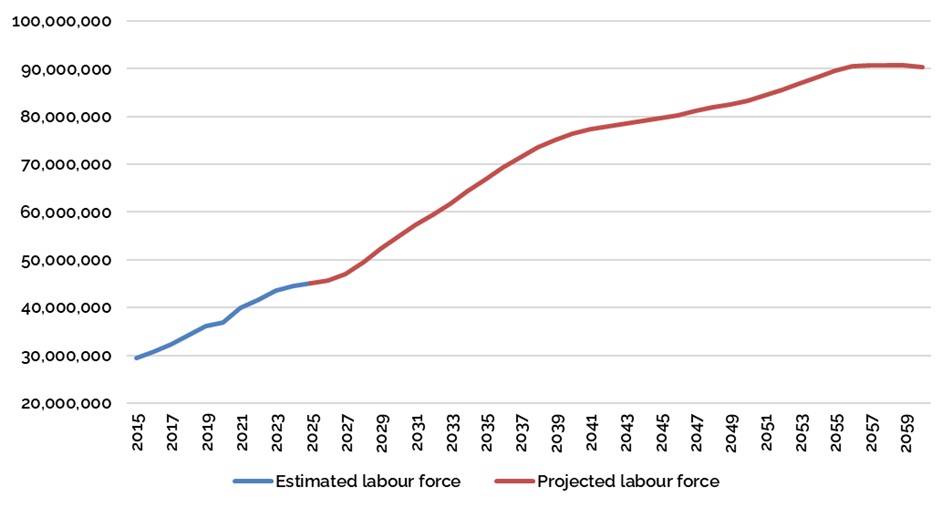
But this growth isn't automatic. ILC research shows that nations that invest proactively in preventative health get a longevity dividend. Healthier older people work longer, spend more, and provide more care.
Without this investment, the potential of the longevity economy will remain locked away.
China’s labour force participation aged 65+, estimated and projected
Source: ILCUK analysis of UN population projections 2024
The ILC's work on China’s longevity dividend
For years, ILC has been at the forefront of analysing this shift. Our reports, including Health equals wealth and Matching the potential, have detailed both the scale of the challenge and the enormous economic dividend available from investing in healthy ageing. Our Healthy Ageing and Prevention Index clearly shows that while China has started its journey, significant gaps in preparedness remain.
What's next? Turning challenge into dividend
This year, with grant support from Pfizer, we are intensifying our efforts to make the business and policy case for investing in healthy ageing to unlock China's longevity economy. This project will demonstrate how a focus on prevention - from vaccination to lifestyle support - can boost labour participation, consumer spending, and social volunteering among older people.
For UK firms, China’s longevity challenge isn’t just a risk - it’s also creating demand for innovation in health, finance, and community services. So, alongside this project, and in partnership with the Foreign, Commonwealth & Development Office (FCDO) in China, we are mapping opportunities for UK-China collaboration on ageing. From health tech and financial services to community design, we will identify how UK expertise can support China's goals while creating new trade and investment channels for British businesses.
What happens now?
China’s demographic destiny will shape not just its own economy, but the global one. The choice is between managing a crisis and harnessing a dividend. The path forward is clear: invest in prevention, adapt workplaces and pensions, and innovate in products and services for longer lives.
We are bringing together senior policy and research experts to discuss this issue on 16 October. If you would like to join this roundtable, please contact David Sinclair at davidsinclair@ilcuk.org.uk.
Declaration: ILC has used AI tools to check spelling, punctuation and grammar and to improve the flow of this article.
David Sinclair & Ben Franklin
ILC's Chief Executive & Deputy Chief Executive
David Sinclair, ILC Chief Executive
David has worked in policy and research on ageing and demographic change for over 20 years. He has a particular interest in older consumers, active ageing, financial services, adult vaccination, and the role of technology in an ageing society. He has a strong knowledge of UK and global ageing society issues, from healthcare to pensions and housing to transport.
Prior to joining the ILC, David worked as Head of Policy at Help the Aged and variously for environmental and disability organisations in policy and public affairs functions. His other experience includes working as a VSO volunteer in Romania, for a Member of Parliament, and with backbench committees.
Ben Franklin, ILC's Deputy Chief Executive
Ben oversees major policy projects and programmes of work for ILC. He is an expert on the intersection of economic and social policy and previously ran the think tank Centre for Progressive Policy, doing ground breaking work on spatial inequality and inclusive growth.
As well as working in think tanks, Ben has worked in the Treasury, Financial Conduct Authority and in the insurance industry.