
Part two: Why act now – the economic opportunities of ageing
5 Sep, 2025
Ageing is often painted as a ticking time bomb for public finances and economic growth. But this ‘problem’ is largely socially constructed. In reality, the UK could reap large economic gains if we tackle health barriers to fuller working lives and unlock the spending power of older consumers. In his second of two blogs Ben Franklin, ILC's Deputy Chief Executive sets out the opportunities of long lives. Read "Part one: Why the longevity challenge needs addressing now" here.
Reframing what ‘old’ means
Demographic change doesn’t have to mean broken public finances and economic stagnation. Part of the bind that the UK and many countries currently find themselves in is the notion that old age starts at 65 or some other arbitrary number somewhere between 60 and 70. But this largely reflects historic pension policies – including pensionable ages and social norms that were set in the mid to late twentieth century and don’t reflect the subsequent continual improvements in life expectancy.
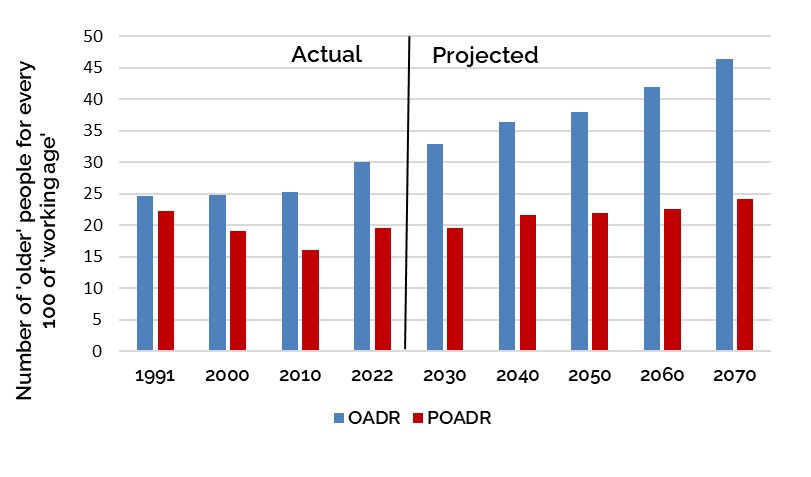
Reframing ageing so that ‘old’ refers not to the over-65s but to the last 15 years of life illustrates that demographic change need not mean rising dependency or mounting fiscal pressure. As the chart below shows, the prospective old age dependency ratio (POADR) flattens over the coming decades. Pension and healthcare spending would be concentrated in these last 15 years while more people would be able to continue being economically active into their 70s.
This is not some crazy utopian idea – many countries at the frontier are already operating models closer to this reality than the UK, with healthier workforces continuing to work into their 60s and 70s.
Figure 1. Redefining old age as the last 15 years of life dramatically alters how we see the ageing ‘problem’
Source: ILCUK calculations based on ONS population estimates, population projections (principal variant) and period life expectancy
The labour supply opportunity
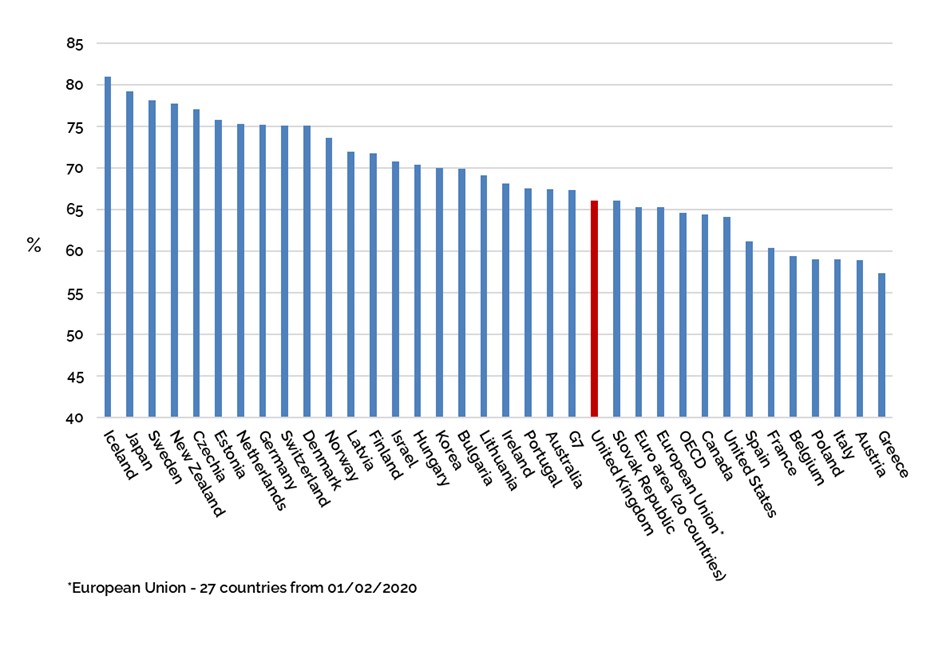
For the UK and many other developed countries, life expectancy gains are not being translated into labour force supply gains – a critical challenge for ensuring improvements in longevity translate into economic growth. There is huge scope for improvement here and other countries are showing what’s possible. For instance, Sweden, Estonia and the Netherlands have employment rates for 55-64-year-olds of above 75%, much higher than the UK (66%).
If the UK could match Sweden’s employment rate for this age group alone, we calculate this could add over 2% to GDP – around £78bn.
Figure 2. 2004 to 2040: employment rates by age group – OECD countries
Source: ILC analysis of OECD data
Health constraints are a particular problem for the UK in this context with economic inactivity due to long-term sickness highly elevated since the pandemic. While all age groups have seen rises in economic inactivity due to long-term sickness, this has been most pronounced among workers aged 50-64.
Overcoming health constraints – both by supporting more preventative health and by redesigning jobs to work around those with pre-existing health conditions – is key and offers potentially striking economic rewards if we can identify the right mix of interventions. The OBR previously modelled different health scenarios for the UK economy and projected real GDP could be 2.5% higher or lower by 2070 depending on whether we face a better or worse path for future health.
Beyond boosting labour supply, reducing health inequalities can also raise labour force productivity (i.e. the output per worker or hour worked). The Northern Health Science Alliance has estimated that ill health accounts for over 30% of the £4 per-person-per-hour productivity gap between the Northern Powerhouse and the rest of England. Improving health outcomes in the North could reduce this gap by up to £1.20 per person per hour, potentially adding £13.2 billion to UK Gross Value Added (GVA).
Figure 3. Economic inactivity due to long term sickness ages 16-64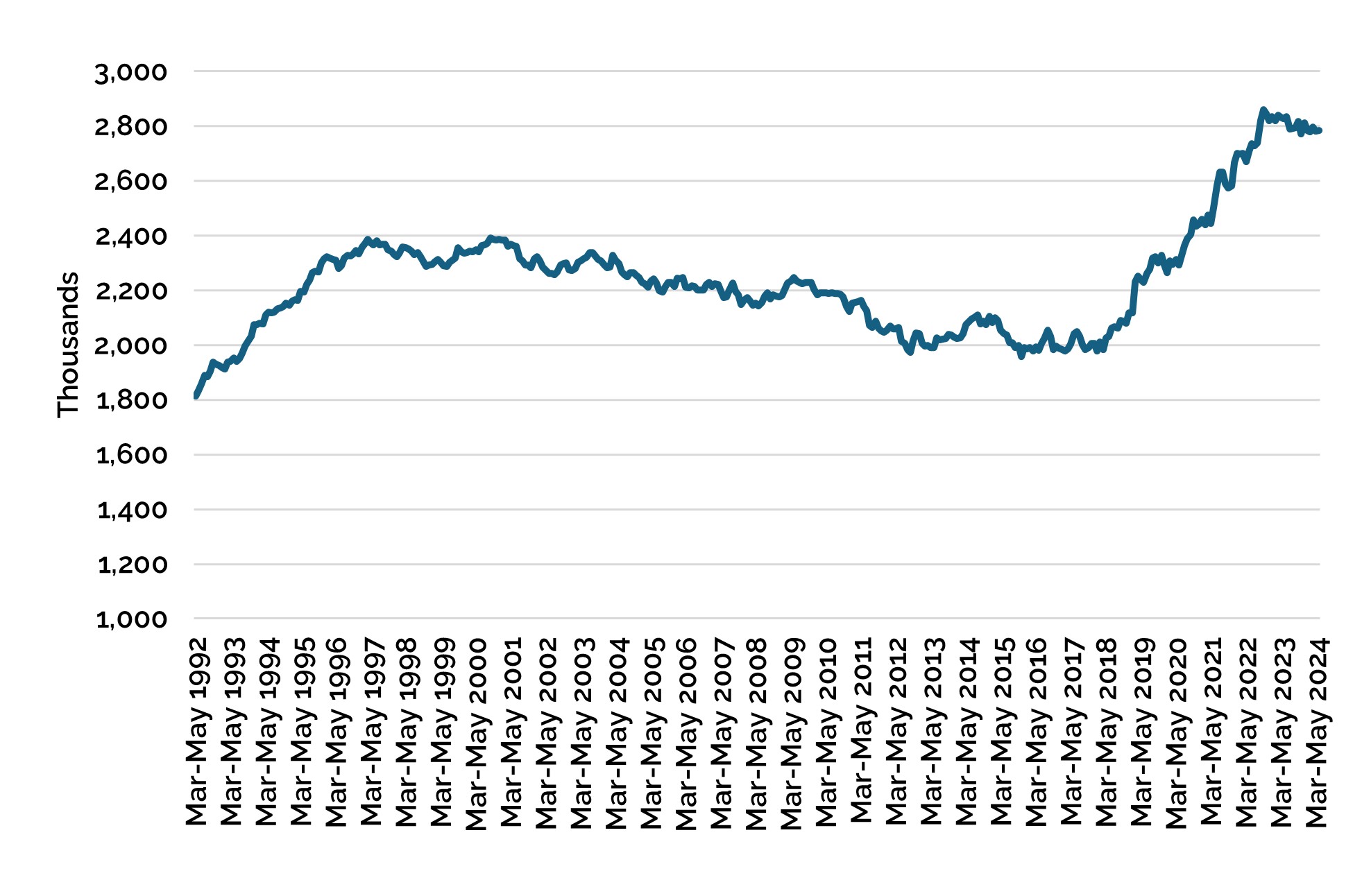
Source: ILC analysis of ONS Labour Force Survey
The consumption opportunity
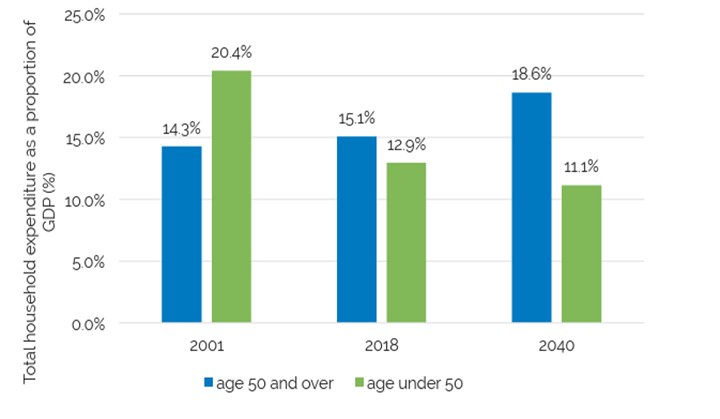
The over-50s now account for the majority of consumption spending in the UK economy. Previous ILC work has calculated that the over-50s spent £319bn in 2018 and that on current trends this would rise to 550bn in 2040. This implies older people’s spending would rise from 54% to 63% of total spending over the next 20 years. Enabling greater consumption among this group needs to be both a goal of government policy to support growth and demand, and an opportunity for firms that understand how best to unlock this market.
Figure 4. Total household spending as a proportion of GDP, by age, in 2001, 2018 (actual) and 2040 (projected)
Source: ILC (2019) Maximising the longevity dividend
Yet older consumers face barriers to spending, with ILC research showing that a drop in income in retirement cannot fully explain the drop in spending. Our research has shown that spending as a share of income falls at older ages, while savings increase; 80- year-olds have been estimated to save an average of £5,870 a year. Too often, rather than being invested productively, these savings end up in low-interest bank accounts.
Recent research from consultancy LCP has found that spending patterns in retirement differ by cohort and patterns of home ownership – individuals who were born at the start of the 20th century increased their spending through retirement, whereas those who were born three decades later were more likely to front-load spending. Homeowners and particularly those retiring more recently are also more likely to front-load.
There is a key role for policy and financial services in understanding these trends and ensuring that people can consume in a way that meets individual needs, while supporting more active ageing and higher economic demand.
Why act now
If we can shift the narrative on ageing - from cost to opportunity - the potential economic rewards are striking:
• Higher labour supply and productivity by supporting longer, healthier working lives.
• A boom in consumption as businesses and policymakers better meet the needs of older consumers.
This is not utopian: many countries are already closer to this future than the UK. With the right mix of health, labour market and consumer policies, ageing could become one of the UK’s biggest economic opportunities.
Declaration: ILC has used AI tools solely to check spelling, punctuation and grammar in this article.
Ben Franklin
Deputy Chief Executive
Ben oversees major policy projects and programmes of work for ILC. He is an expert on the intersection of economic and social policy and previously ran the think tank Centre for Progressive Policy, doing ground breaking work on spatial inequality and inclusive growth.
As well as working in think tanks, Ben has worked in the Treasury, Financial Conduct Authority and in the insurance industry.
