
ILC in Bangkok: Do the World’s Finance Ministers care about ageing?
20 Oct, 2026
David Sinclair, ILC Chief Executive, argues that population ageing is no longer a rich-world story – and that the world’s finance ministers have not yet caught up with that reality. With the UK’s G20 Finance Ministers meeting in Edinburgh in July 2027, Sinclair argues the window to act is open – but narrowing faster than most governments yet appreciate.
At the IMF–World Bank Annual Meetings last week, finance ministers, central bank governors, and a media circus filled every conference room and rooftop bar from Sukhumvit to the riverside.
ILC was there to get a feel for where the world’s financial leaders stand on the defining economic challenge of our time: demographic change.
We hosted two events. On Wednesday evening, an off-the-record dinner – Addressing the demographic challenge: long lives as a fiscal opportunity – brought together senior policy specialists, economists and health experts. On Thursday, we convened a high-level roundtable on the emerging findings of our Longevity Dividend Modelling Framework, supported by IFPMA.
At the beginning of the week, the IMF Managing Director, Kristalina Georgieva, was warning that France faces a long road to fiscal credibility, calling on governments to make "urgent repairs to the fiscal house before the cracks widen."
Ageing and pension costs sit at the centre of France's challenge.
Signs of progress
Four or five years ago, ILC held a comparable event at the World Bank in Washington and struggled to fill a room. Last week, both our events were oversubscribed.
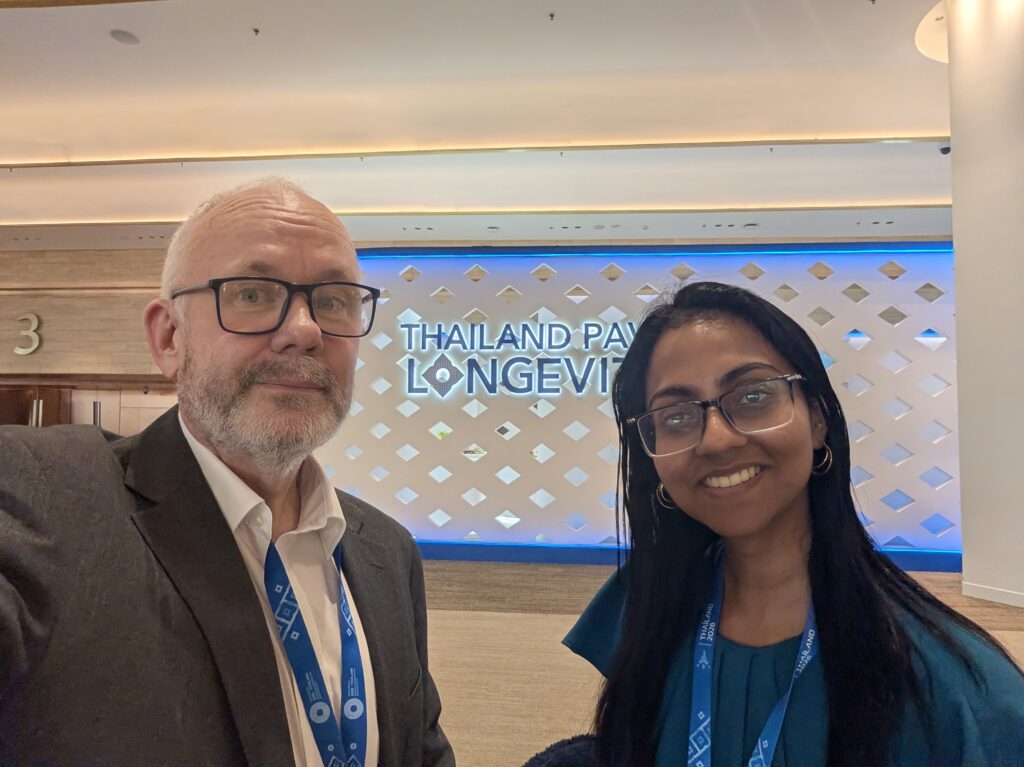
Thailand – as host nation – devoted a prominent pavilion to the realities of longevity, placing healthy ageing, prevention and long-term care at the centre of its national showcase. And a speaker at a major IMF session described demographic change and climate as the two defining challenges facing society.
The formal programme contained just one session on demography. It was convened by the Japanese government. The World Bank's Vice President for People, Mamta Murthi, used it to describe ageing as "the most consequential but underestimated development challenge of our era" and to question explicitly whether mandatory retirement still makes sense in a world of longer, healthier working lives.
Japan's Vice Minister of Finance set out what early action looks like: universal pension and healthcare were both introduced in 1961, long-term care insurance in 2000 – well before peak ageing arrived. Japan's care economy grew from 3.6 trillion yen in 2000 to 15 trillion yen today and now employs 2.1 million people.
The gap between what finance ministers acknowledge and what makes the formal agenda remains wider than it should be though. When Argentina's Finance Minister was asked about ageing in one session, he said he was not ignoring it because it was unimportant – but because it was the most important challenge he faced. He needed to get fiscal consolidation right first.
But if countries wait for fiscal stability before addressing demographic change, they will likely find that demographic change makes it harder rather than easier to achieve.
The AI question
One of the most thought-provoking sessions I attended featured the IMF Managing Director, the Governor of the Bank of Canada, Jack Clark of Anthropic and the CEO of DHL.
The panellists found it easier to articulate the risks of AI than the opportunities. When asked how they personally use it, answers ranged from managing a diet to checking chicken nuggets are safe for a toddler. Nobody – despite running organisations at the frontier of AI adoption – could quite bring themselves to say clearly how it changes what they do every day.
Perhaps that is honest. Perhaps it tells us we are still in the gap between knowing AI is transformative and knowing how to use it well.
As ILC's own work has shown, AI is already capable of interpreting medical scans with greater accuracy than many clinicians, supporting independent living through sensors and wearables, and dramatically accelerating drug discovery – compressing timelines that once took decades into years. The potential to extend healthy working lives, support caregiving at scale and drive productivity in ageing workforces is substantial.
Prevention and pandemics
A session on health and private capital made a compelling case for prevention as fiscal investment. The $700 billion annual average cost of pandemic response was cited as evidence of the structural gap in financing preparedness between crises. The case for private capital alongside public funding was well made.
Ageing isn't a rich-world story any more
At an event convened by AARP, we heard that by 2050, 80% of the world's over-60s will live in lower and middle income countries. Africa alone faces a nearly 400% increase in its population aged 60 and over.
Thailand – host to these meetings – is on track to become a super-aged society by 2033, at a far lower income level than any peer country managed the same transition. The World Bank launched its Thailand Country Aging Report at the meetings. Its central finding was not that Thailand lacks policies – rather, it faces an implementation gap.
The G20: an opportunity for the UK to lead
The UK Chancellor, John Healey, was in Bangkok, setting out his priorities for the UK's G20 presidency: growth, AI, international finance, and supporting developing countries through debt.
It is a pity that demography did not feature. It is not a criticism so much as an observation about where we are. The conversation is moving, but the formal agenda has not yet caught up with the private acknowledgement that ageing matters.
The G20 Finance Ministers and Central Bank Governors will meet in Edinburgh in July 2027. The Finance Track agenda is being shaped now. Lord Stewart Wood, now an FCDO minister, argued earlier this year that the UK's G20 presidency presents a rare opportunity to show decisive global leadership on demographic change. ILC estimates that if G20 economies employed the same proportion of people aged 50 and over as Iceland, global earnings could rise by $3.7 trillion.
The UK needs to use Edinburgh to get demography firmly onto the agenda.
A final thought
With a free Saturday morning in Bangkok, I visited the Kidmai Death Awareness Exhibition – a café and immersive experience that invites visitors to simulate the physical experience of ageing, to lie in a coffin for three minutes, and to write a vow about how they will live differently.
It was, after a week of data and roundtables and high-level panels, the most direct confrontation with ageing – and its wasn't about fiscal sustainability or GDP.
Bangkok showed the world is edging closer to asking the right questions. That is why ILC was there – and why the work continues.

David Sinclair
Chief Executive
David has worked in policy and research on ageing and demographic change for over 20 years. He is a recognised expert on longevity, with particular interests in older consumers, active ageing, financial services, adult vaccination and the role of technology in an ageing society. He has deep knowledge of UK and global ageing issues, spanning health and care, pensions, housing, transport and consumption. David regularly presents internationally on longevity and demographic change and has published widely on topics including transport, technology, health and consumer markets. David is an international advisor to the Sau Po Centre on Ageing at the University of Hong Kong and a member of the external advisory board for the University of Surrey Centre of Excellence on Ageing. He has worked with the pan-European AGE Platform for 15 years and is a former vice-chair of the government’s Consumer Expert Group for Digital Switchover. Prior to joining the ILC, David was head of policy at Help the Aged, leading a team of policy advisers, and has held senior policy and public affairs roles across the voluntary sector.
