
Better vaccines, better outcomes: European countries could reduce hospitalisations and save millions in costs by using more innovative flu vaccines
14 Oct, 2026
Alongside EU Respiratory Day on 14 October, ILC’s Head of Partnerships and External Relations, Patrick Swain, explores new ILC evidence that suggests that using more effective vaccines and hitting the 75% influenza (flu) vaccination target could drastically reduce hospital costs in some European countries.
It has been 17 years since the Council of the European Union recommended a 75% flu vaccination target for people aged 65 and over. In that time, advances in vaccine technology have helped to improve the efficacy of flu vaccination.
Every winter produces different strains, and senior health officials play an annual guessing game of “how well will this vaccine work?” As vaccines continue to improve, this uncertainty seems likely to become a thing of the past.
As part of Flu Forward: Influenza innovation for healthy ageing, ILC has been speaking with experts across Europe to build a consensus on how best to use these newer, more effective vaccines. We’ve also crunched the numbers from the 2025 FLUNITY-HD study to better understand how adopting new flu vaccines could support health systems in Europe and beyond.
What did we find?
Looking at 2023/24 flu vaccination coverage in five countries – France, Germany, Italy, Japan, and the UK (England only) – we see that most fell well short of the 75% target.
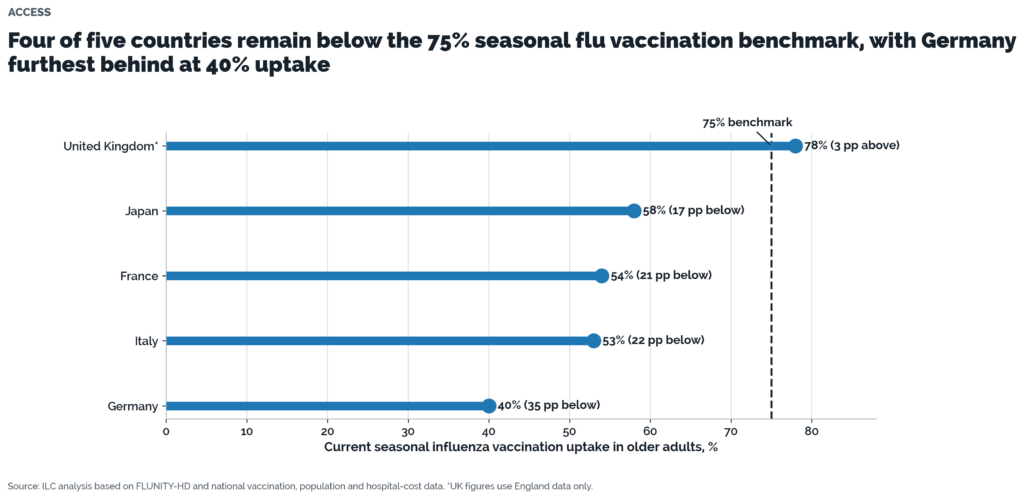
Four of these countries fell between 17 and 35 percentage points below the target. Progress on vaccine technology will become redundant if jabs aren’t getting into arms: a better vaccine does nothing for the unvaccinated.
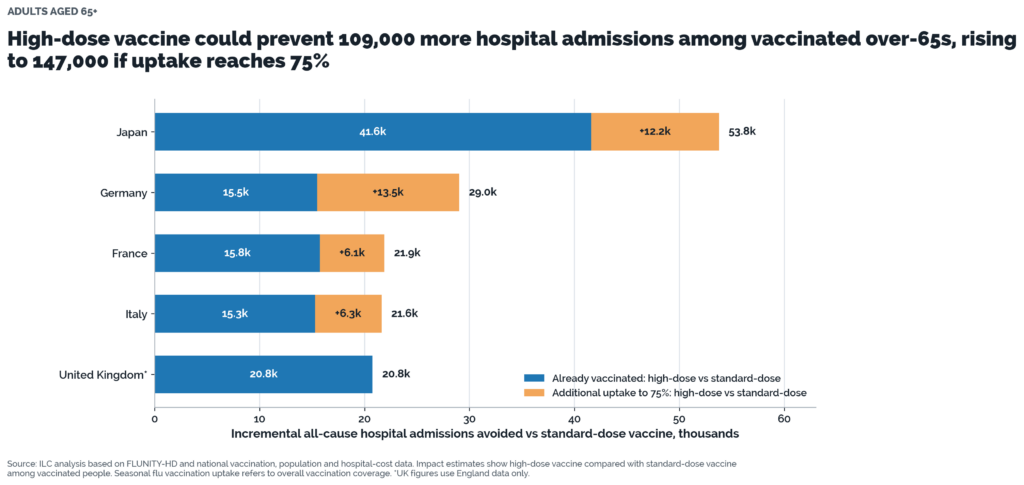
Yet even with these current uptake levels, adopting more effective vaccines could prevent 109,000 hospital admissions among older adults compared with standard vaccines.
Reaching the 75% benchmark, though, is vital to realise the full effect of these improvements. Our analysis shows that a further 38,000 hospitalisations could be prevented if these four countries had 75% flu vaccination uptake. That’s 147,000 people who could be better protected from the flu – if they got vaccinated with a more effective flu vaccine.
But what if we lowered the flu vaccination age to 50?
While FLUNITY-HD looks only at adults aged 65 and over, we have used the study to estimate the impact of flu vaccination for adults aged 50–64. In these scenarios, hospitalisations could fall significantly.
Offering a more effective vaccine from age 50 at 75% uptake could prevent 271,000 admissions, compared with 147,000 for over-65s. Japan would avoid 91,900 and Germany 56,100. In the UK, avoided admissions would almost double – from 20,800 to 40,900. France and Italy would see similar results.
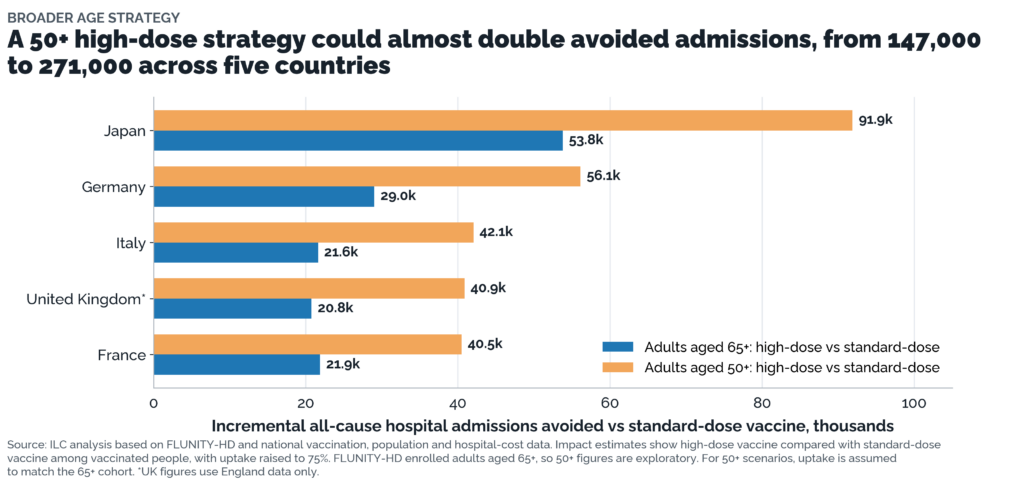
ILC’s previous research exploring immunosenescence suggests that lowering the current flu vaccine age recommendation from 65 to 50 is crucial to ensure adults have a better chance of eliciting an immune response to vaccination. These new findings strengthen the case for a change in age recommendation – keeping people out of hospital and economically active is key in an ageing society.
How much could governments save, too?
Fewer admissions mean lower hospital bills. We estimate direct savings of €683 million across the five countries if over-65s receive an improved vaccine at today’s uptake. If adults aged 50 and over receive it at 75% uptake, savings reach €1.7 billion at 2025 prices. Japan would save €612 million, Germany €428 million, the UK €264 million, France €226 million and Italy €182 million.
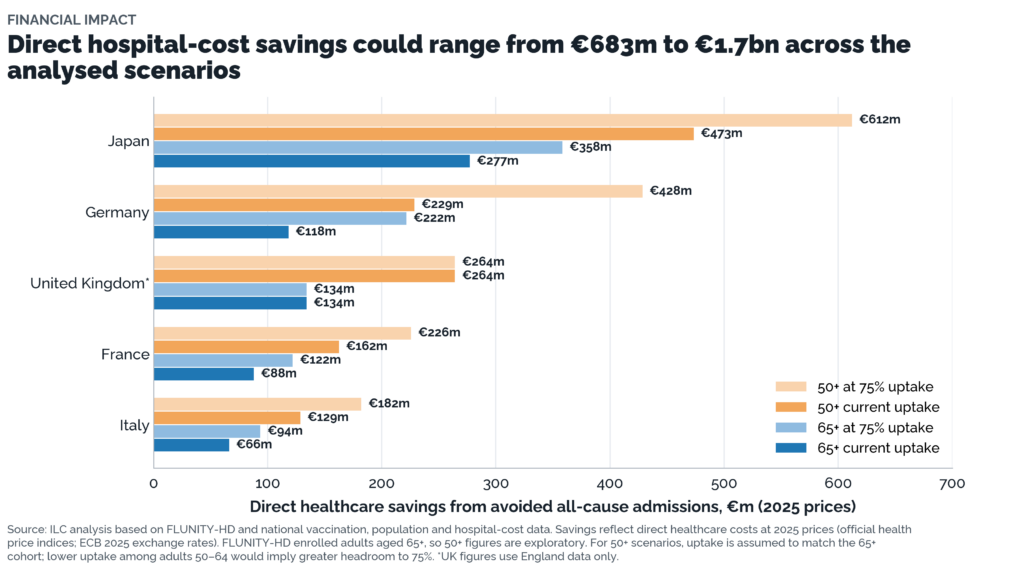
Germany’s savings more than triple between the lowest and highest scenarios, from €118 million to €428 million. In the UK, where coverage is already strong, these savings would almost double from €134 million to €264 million if flu vaccination started at 50.
And these are just hospital savings. The broader societal and economic impact may be even larger. ILC has already found that countries that spend more on prevention see more older adults working, spending, and volunteering in later life.
What happens next?
These findings underline the need for greater consensus on achieving higher flu vaccination coverage while recognising the health and economic value of innovative vaccines. We have developed a consensus statement setting out seven policy principles:
- Recognise influenza as a serious risk as we age
- Position vaccination as core prevention policy
- Use the most effective vaccines for older adults
- Embed vaccination in routine NCD care
- Drive high and equitable uptake
- Value prevention in economic decision-making
- Strengthen data and accountability
We will officially launch these findings and our consensus statement at our third annual ILC Europe Network conference in Brussels on 19 November 2026.
To find out more about the Flu Forward project and to endorse the consensus statement, please email Patrick Swain at PatrickSwain@ilcuk.org.uk.

Patrick Swain
Head of Partnerships and External Relations