
Caring for family pushes more women out of work in London than anywhere else in Britain
16 Jul, 2026
As Baroness Casey prepares to publish the first report of her Independent Commission on Adult Social Care, new analysis from the International Longevity Centre UK (ILC) shows a hidden cost of care in the capital. London has the highest rate of women pushed out of work by caring responsibilities of anywhere in Britain – more than nine times the rate for London's men.
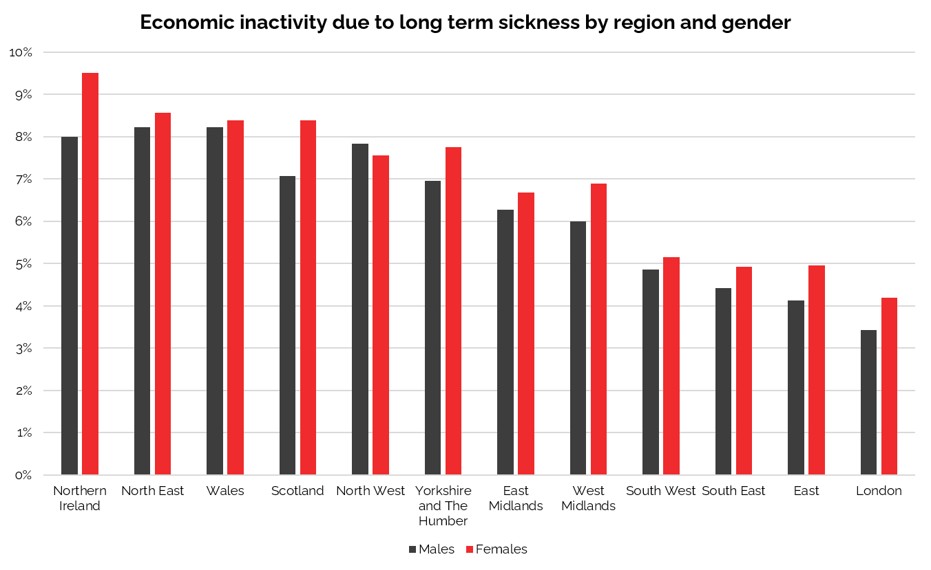
Economic inactivity due to looking after family/home by region and gender. Source: ILC analysis of NOMIS Annual Population Survey 2025.
Men's economic inactivity due to caring for family sits between 1% and 2% in every region of the UK, while the rate for women in London reaches 8.3% – the highest of any region in Britain, and more than nine times the rate for London's men. In absolute terms, 256,800 women in London are economically inactive due to caring responsibilities – more than a quarter of a million – compared with just 27,100 men. The scale of the gap is considerable given London's wealth – the capital outperforms the rest of the country economically, yet its women are more likely than anywhere else to be out of paid work due to caring responsibilities.
Ben Franklin, ILC’s Deputy Chief Executive commented, “London is the richest region in the country, yet nowhere are women more likely to out of work by due to caring responsibilities and its holding back the capital’s prosperity. With an incoming government looking for growth levers, supporting carers – whether childcare or social care – better juggle work and care throughout their lives should be seen as an economic priority. As Baroness Casey prepares to publish her first report on social care, we want to see recommendations that recognise caring is holding back London as much as anywhere else in Britain – and a government ready to act on them.”
ILC sets out how to close these gaps in its new briefing, Why now: delivering good growth through the longevity economy.
In addition to ILC’s analysis above this briefing document highlights several other findings, including:
- 5 million people aged 50 to 65 have been pushed out of work early through redundancy, ill health or caring
- Closing the employment gap between the UK's lagging and best-performing local areas for 50- to 64-year-olds would add £19.4 billion to the economy
- If the UK was to match Sweden’s employment rate for workers aged 55 to 64 it would add £78 billion to GDP
The ILC sets out recommendations for the new leadership's first 100 days, including:
- Treat support for carers of children and older adults across the life course as an investment in the labour market, committing to accelerate reform following the Casey review of social care
- Require local growth plans – including in London – to treat better health as a core outcome of investment, so growth strategies close these gendered gaps too.
- Give the longevity economy an explicit mandate within the founding programme of No.10 North, Andy Burnham's proposed Manchester-based unit – which ILC believes should be given a clear economic policy innovation remit
- Rename and relaunch Jobcentre Plus as a Stronger Working Lives Service, with combined authorities leading joined-up delivery across the whole of working life.
The full ILC briefing – Why now: delivering good growth through the longevity economy – is available here
Ends
Contact: For press queries, please contact press@ilcuk.org.uk. Spokespeople are available for interview.
Notes and references
London and other regional inactivity figures are based on new ILC analysis of NOMIS Annual Population Survey 2025 accessed via Nomis https://www.nomisweb.co.uk/
Additional analysis in the briefing includes:
- ILC (2025) The UK Better Lives Index. London: ILC. Available at: https://ilcuk.org.uk/wp-content/uploads/2025/09/ILC-UK-Better-Lives-Index.pdf
- ILC estimate based on: OECD data for 2025 (Annual GDP and components, expenditure approach, US$ current PPPs; Employment by age group, ages 55–64; Employment, all ages). For each of the 38 OECD member economies, the additional 55–64 workers required to reach the top-quartile target rate (77.4%, the unweighted average of the ten OECD economies with the highest 55–64 employment rates in 2025: Iceland, Japan, Sweden, Czechia, New Zealand, Estonia, the Netherlands, Switzerland, Germany and Denmark) were calculated as: (target rate − current rate) × 55–64 population, where 55–64 population is derived as 55–64 employment ÷ employment rate. The GDP uplift was estimated by multiplying additional workers by each country's average labour productivity (GDP ÷ total employment). Aggregate figures are expressed in PPP US$. Where 2025 values were unavailable (US employment rate, Costa Rica GDP), the 2024 value was used. The ceiling scenario benchmarks every economy to Iceland's 2025 rate of 81.8%, the highest in the OECD. Source: OECD Data Explorer, accessed 30.06.2026. Figures rounded.
- ILC calculation applying the methodology developed in ILC (2014) The Missing Million: Illuminating the employment challenges of the over-50s. London: ILC, to DWP (2025) Economic labour market status of individuals aged 50 and over: trends over time, September 2025. Available at: https://www.gov.uk/government/statistics/economic-labour-market-status-of-individuals-aged-50-and-over-trends-over-time-september-2025
About ILC
ILC is the UK’s leading authority on the impact of longevity on society. We combine evidence, solutions and networks to make change happen.
We help governments, policymakers, businesses and employers develop and implement solutions to ensure we all live happier, healthier and more fulfilling lives. We want a society where tomorrow is better than today and where future generations are better off.
ILC wants to help forge a new vision for the 100-year life where everyone has the opportunity to learn across our lives and where new technology helps us contribute more to society.