
Why now – delivering good growth through the longevity economy
17 Jul, 2026
ILC briefing paper – July 2026
Summary: about this briefing
With a new leadership in place and a renewed focus on good growth in every postcode, the International Longevity Centre UK (ILC) is setting out the economic case for treating demographic change as a critical engine for economic opportunity. The longevity economy – unlocking the economic potential of longer lives in all places – can help deliver the incoming government’s vision of good growth at scale.
Government policy currently treats welfare, skills, health and consumer markets as separate problems, often narrowly defined: welfare judged mainly on cost control rather than on keeping people in economic life, skills as something for young people, health as an NHS budget line, older consumers as a niche market. These approaches made more sense when most economic activity happened in a shorter, earlier stretch of life. They make far less sense in a country where people are living decades longer, but too often not working, spending or staying healthy for nearly as long. The new government has a chance to rewire our economy differently, to help us catch up and push the frontier.
The vision
One of the UK’s biggest untapped opportunities for growth is sitting right under our noses.
The UK urgently needs an economy designed around long lives. One that supports people to work for longer wherever they live, that enables them to remain active economic participants throughout their lives, and that fosters markets and services that work for all people and places.
This is good growth in action – an economy that works for everyone, at every stage of life. We call it the longevity economy.
Many of the countries that have gone furthest towards a longevity economy – Sweden, the Netherlands, Germany and Switzerland – enjoy higher employment rates, higher GDP per head and stronger public finances. The UK has the same demographic opportunity, but it needs a government with the long-term ambition to seize it.
A change of leadership brings a renewed optimism. New ministers want to be judged on delivery, not inheritance, and that creates room for ambitious ideas that may have stalled under the previous administration.
But ILC has watched good policy ideas fail before, not because the evidence was wrong but because of how they were introduced. Policy reforms announced piecemeal, without a clear framework joining them up, leave each one isolated and exposed. Ministers then face concentrated public and media pressure with no wider narrative to defend the policy, and U-turn. The reversal of the winter fuel payment changes and the retreat on disability benefit reforms are recent examples of this pattern. A longevity economy strategy provides a framework that can hold individual decisions together, so they are defended as part of a coherent growth story rather than abandoned in isolation.
Writing in LabourList, Lord Stewart Wood argued that rising longevity represents an economic opportunity and that the G20 presidency offers a chance for Britain to lead internationally on this agenda. ILC has been building the evidence and making the case from the global to the local - from G20 finance ministers to Greater Manchester's night-time economy.[1]
ILC is therefore calling on the next government to adopt the longevity economy as a central pillar of its good growth mission. This briefing sets out the principles that underpin this approach, the problem statement and the evidence base.
Embedding longevity economy principles in the first 100 days
No.10 North should be the UK’s home for radical economic policy innovation.
The Treasury is good at managing fiscal risk and challenging spending proposals. It is not designed to generate or test new economic ideas. No.10 North, with direct PM oversight, could fill that gap, bringing new economic thinking, such as the longevity economy, to bear on place-based growth, testing and scaling what works and building regional capacity.
In the first 100 days: establish No.10 North with an explicit economic policy innovation mandate. With older workers, older consumers and healthy ageing shaping the growth potential of every part of the UK, the longevity economy should be part of its founding programme.
Government policy typically treats young adults and older workers as separate labour market problems to be fixed. The longevity economy focuses on whole working lives, not isolated age groups, to drive long-term growth.
Young people not in employment, education or training (NEETs) and economically inactive older workers face different but overlapping barriers – with poor health and skills gaps featuring at both ends of working life. Government needs to design support across the whole of working lives to maximise the UK’s economic potential.
In the first 100 days: Rename and relaunch Jobcentre Plus as the Stronger Working Lives Service - with a clear mission to support good work and skills across the whole of working life. Commit to combined authorities leading joined up devolved delivery across employment, health and skills within six months. Treat support for carers of children and older adults as an investment in the labour market, committing to accelerate social care reform following the Casey review.
Government policy typically treats health as a cost to be controlled. A longevity economy framework treats better health as economic infrastructure.
The OBR estimates the UK economy could be 2.5% larger or smaller depending on the health path we take from here and every year of poor health and rising inactivity drags on our productivity potential.
In the first 100 days: require that local growth plans include better health as a core outcome of investment and activity - and that any new “good growth funds” follow the same principle. Nationally, commit to reclassifying preventative health as similar to capital investment, so that when public finances allow, government can borrow to invest in health the same way it can borrow to build railways.
Government policy traditionally treats inequalities in life chances as something Whitehall has to solve. A longevity economy approach needs a national focus, but it must be strategically driven and implemented locally.
ILC’s Better Lives Index shows that access to the conditions for a good life, from birth to old age, varies enormously across the UK.[2] Closing those gaps requires national ambition and investment, but delivery that is shaped and led by regions, local government and neighbourhoods, not designed once in Whitehall and universally rolled out.
In the first 100 days: bring forward ambitious fiscal devolution proposals that would give combined authorities greater economic power. To complement this, introduce a statutory instrument enshrining the right to economic participation across the whole of life - in every place - giving Burnham's invocation of gleichwertige Lebensverhältnisse legal force.[1]
Government policy intersects with older people’s income and wealth mainly through the prism of means-tested benefits and social care. A longevity economy framework means asking how older consumers’ income and wealth can grow the economy instead.
The over-50s already account for the majority of UK consumer spending, and spending falls as wealth rises in later life – even though people have the means to spend more. Better products, services and financial confidence would let more of that wealth and spending power flow into the economy as jobs and demand.
In the first 100 days: publish the long-awaited housing strategy to explicitly address later life housing supply and downsizing, helping to free up housing wealth that never reaches the economy and family-sized homes that don’t reach younger buyers. Require that the ongoing pensions commission and Casey review model the impact of their proposals on consumer spending and precautionary savings.
The problem – a snapshot
The UK’s decades long economic stagnation is a story about failing to capitalise on the huge potential of its people. With longer lives, that potential has never been greater, but due to deep inequalities in life chances between places, and outdated policies and institutions, this economic opportunity and human potential is being squandered.
Take work. Supporting people to enter and stay in work could substantially add to our GDP. This is achievable – other countries are showing the way. If the UK matched Sweden’s employment rate for those aged 55–64, we’d add £78 billion to the economy.[3] Yet in some parts of the UK, half of those aged between 50 and State Pension Age are out of work and not looking for work.
Behind the older worker employment gap are multiple barriers. Poor health and caring responsibilities play a significant role. The UK has fallen further behind comparable countries on life expectancy and several other key health indicators.[4] Too many people are leaving work in their 50s not by choice but because their health fails or because they are supporting a loved one. The UK underinvests in adult and technical education relative to its peers, leaving workers without the skills to enter the workforce, adapt and progress across their working lives.
Sir Charlie Mayfield's Keep Britain Working programme has now signed up nearly 200 employer "Vanguards" to tackle health-related economic inactivity[5] – but it only seeks to address these workforce challenges through employers rather than being part of a wider growth strategy. A longevity economy strategy would connect the challenges around inactivity to the broader skills, health, and place-based agendas set out here, rather than treating it in isolation.
Beyond the labour market, older consumers represent a largely neglected source of economic growth. The over-50s already account for 55% of total UK consumer spending but face systematic barriers to spending, and businesses have not done enough to design products and services that work for everyone.
The following sections set out the scale of the challenge and opportunity across these three dimensions – the labour market, healthy ageing, and the consumer economy.
The labour market opportunity
Globally, many economic strategies are overlooking a critical source of labour supply – workers in their 50s and older. ILC estimates that if OECD economies matched the 55–64 employment rate of those countries that have the highest employment rates for this age group, it would raise overall GDP by $2.9 trillion, or 3.3%. If lagging economies matched the top country, Iceland, it would amount to nearly $4 trillion, or 4.4% of GDP.[6]
The economic opportunity of catch up is closer to home too. ILC’s UK Better Lives Index shows that even a conservative scenario, where lower-performing local authorities simply catch up to the average employment rate for older workers among similar places, would add £19.4 billion to UK economic output, rising to £109 billion in a more ambitious convergence scenario.[7]
The government’s industrial strategy will impact on the chances for good work across the life course and in all places. ILC’s analysis shows that the places ranked lowest on our index of the best places to grow up and grow old also tend to have the lowest existing employment in the priority sectors in the current industrial strategy, with advanced manufacturing a notable exception. Without deliberate policy design, the transition to the sectors of the future risks reinforcing rather than narrowing these inequalities. A longevity economy strategy would seek to ensure all people and places can live a good, long life underpinned by good work.[8]
The UK is moving in the wrong direction. While most comparable economies have improved older worker employment since the pandemic, the UK has flatlined. ILC analysis shows 1.5 million people aged 50–65 who are currently economically inactive or unemployed were pushed out of work early, through redundancy, ill health, caregiving or early retirement.[9] At the same time, the UK has gone backwards on youth employment, with NEET rates now above both the OECD and EU averages.[10] We are one of the only developed economies to have lost ground at both ends of the working age spectrum simultaneously since 2019.
The UK's underperformance extends to older workers who are well educated. Among graduates aged 55–64, the UK employment rate is 71% - well below Italy, Sweden and Germany where over 8 in 10 graduates of this age are in work.[11]
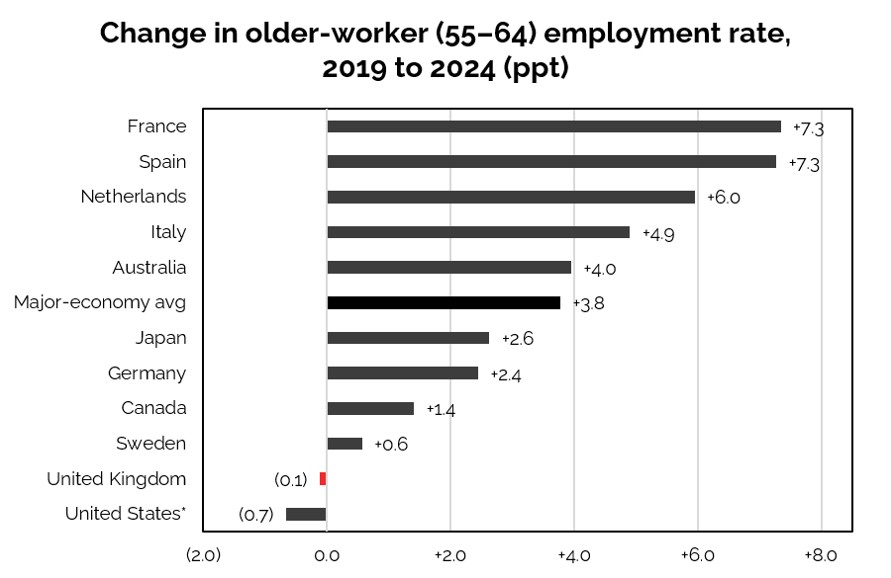
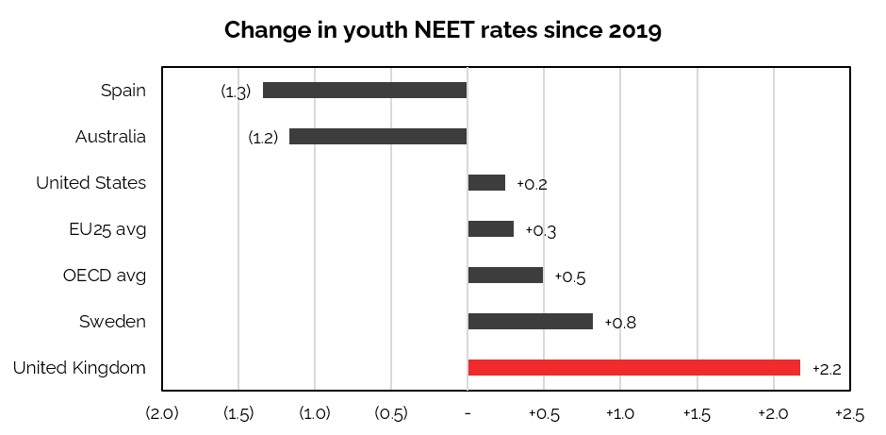
Source for charts: ILC analysis of OECD data
A Longevity Economy Strategy would treat meaningful longer working lives for all people and places as a core growth priority and would develop welfare, skills and employment reforms with this firmly in mind.
£19.4bn
If lagging local areas caught up with the employment rate of 50-64 year olds in similar places
1.5 million people aged 50 to 65
Are pushed out of work early in the UK through redundancy, ill health, caregiving or early retirement
Healthy ageing as economic infrastructure
The conventional view treats the health of the population as a cost to be managed. The longevity economy argument is that investment in healthy ageing is one of the most powerful growth levers available to government.
ILC analysis of the Human Mortality Database shows UK life expectancy improvement substantially stalled from 2013, years before the pandemic accelerated the nation’s worsening health.[12] The UK ranks 28th globally for health span despite ranking 16th overall in ILC’s Healthy Ageing and Prevention Index.[13] The Health Foundation has calculated that at the rate of improvement seen in recent years, it would have taken 192 years to meet the previous government’s healthy life expectancy target.[14] Meanwhile, a 19-year gap in healthy life expectancy persists between the most and least deprived areas of England.[15]
Large health inequalities lead to economic inequalities. Nearly 1 in 10 women aged 16–64 in Northern Ireland are economically inactive citing long term sickness, compared to nearly 1 in 20 in the South East. The devolved nations and the regions of the North of England also see high levels of inactivity due to poor health. In general, women are more likely to be pulled out of the labour market due to sickness than men.[16]
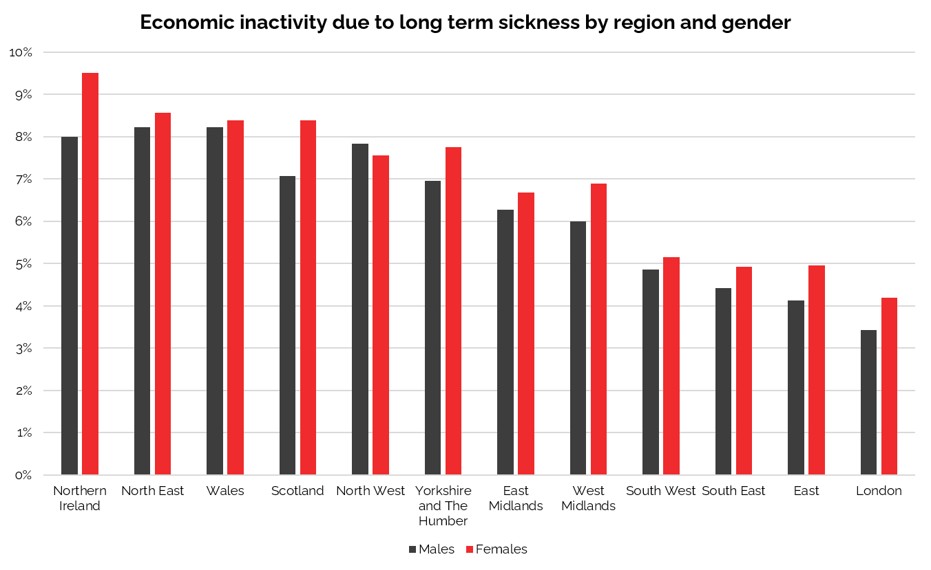
Source: ILC analysis of NOMIS Annual Population Survey 2025
Economic inactivity due to providing care is even more gendered, with women far more likely to be out of work for reasons related to caring for family than men. Again, there are wide regional differences, with women in London experiencing a particularly high rate of inactivity for this reason (over 8%), followed closely by the North East.[17] Care in this context will encompass both care of children and as well as care of older adults, revealing the importance of support across the lifecourse to enable greater labour market participation particularly for women.
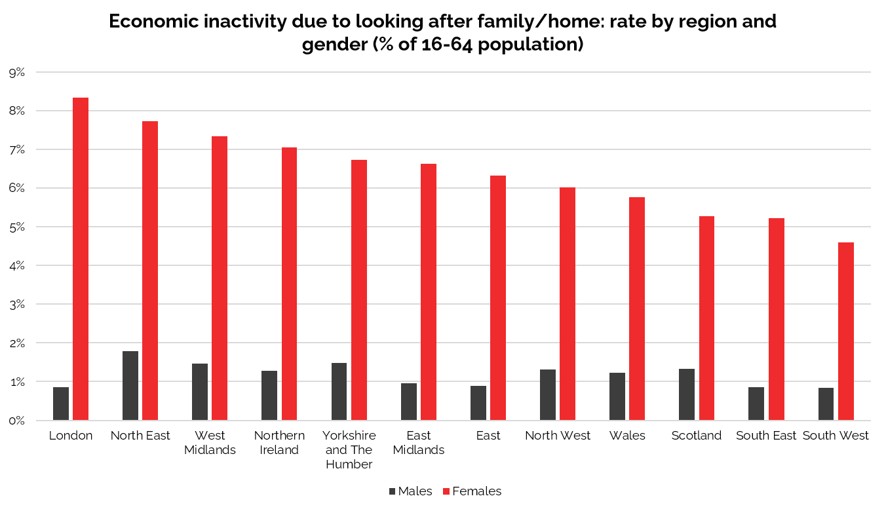
Source: ILC analysis of NOMIS Annual Population Survey 2025
Prior ILC research has quantified how people in good rather than poor health are significantly more likely to be in work in their 50s and 60s, and the gap widens sharply with age.[18] The OBR’s modelling shows that GDP could be 2.5% higher or lower by 2070 depending on whether the UK takes a better or worse health path.[19] At the regional level, the Northern Health Science Alliance has estimated that ill health accounts for over 30% of the £4 per person per hour productivity gap between the Northern Powerhouse and the rest of England, with potential GVA gains of £13.2 billion from closing it.[20]
This is the health-growth relationship that conventional economic strategy often misses. Healthier places are more productive places, not as a side effect of growth but a precondition for it. A government serious about regional economic rebalancing cannot achieve it without treating healthy ageing as economic infrastructure.
2.5% higher GDP by 2070
According to the OBR if the UK’s health improves relative to a scenario where it worsens
19 years
Gap in healthy life expectancy between the most and least deprived areas of England
The consumption dividend
The longevity economy opportunity is not limited to the labour market. The over-50s already account for 55% of UK consumer spending and this share is projected to rise to 63% of all household spending by 2040.[21] On a per-person basis, households aged 65–74 spend more than any other age group in the country – with recreation and culture accounting for nearly 15% of their weekly household budget.
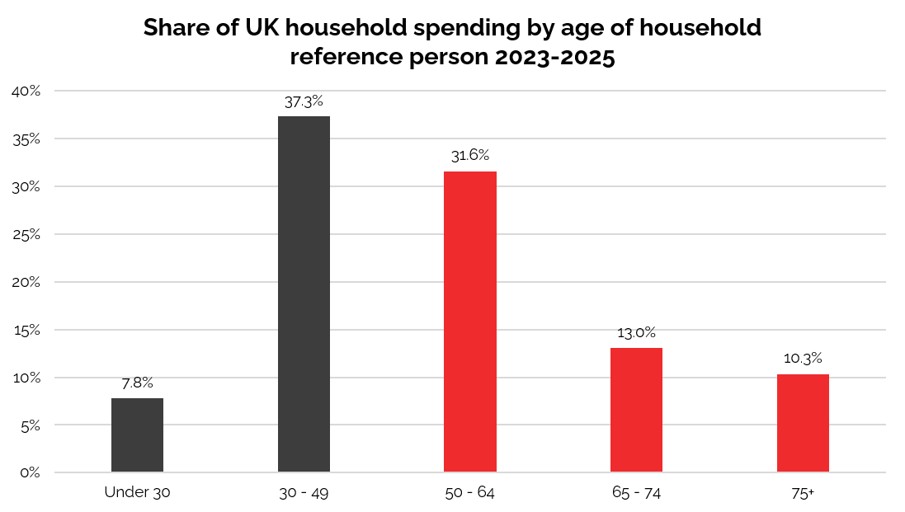
Source: ILC calculations using ONS Family Spending, UK, three-year average FYE 2023 - FYE 2025
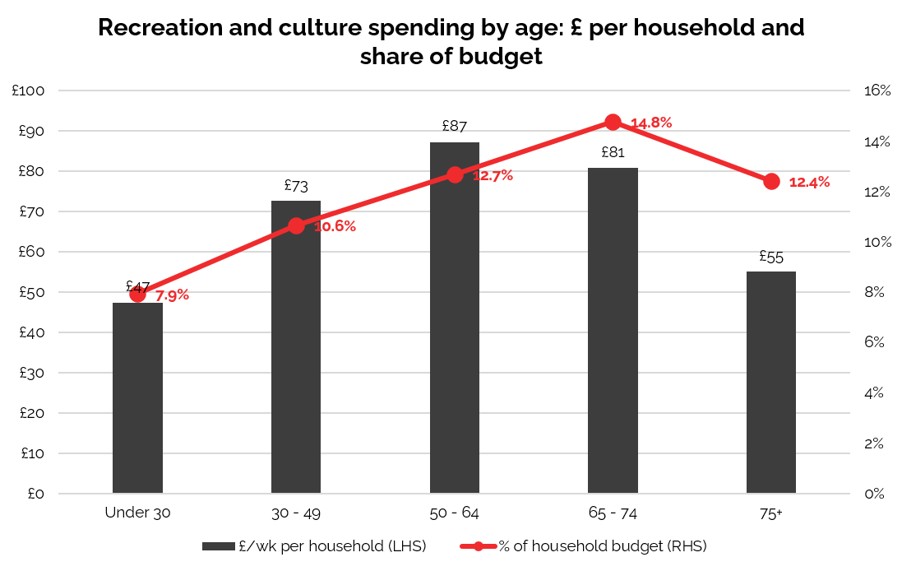
Source: ILC analysis of ONS Family Spending, UK, three-year average FYE 2023 - FYE 2025
The spending paradox is that older consumers are not spending in line with their wealth. People aged 55 and over have on average 25 times the assets of those aged 16 to 24, yet ILC research shows spending as a share of income falls sharply at older ages while savings increase.[22] Despite 1.7 million more people being over 65 than a decade ago, their spending has increased by just 3.5%.[23] The gap between older people’s wealth and their spending reflects real barriers – to suitable products, accessible services, and retail environments designed around their needs – rather than simply a preference to save.
The opportunity is tangible at the regional level too. Working with Greater Manchester Combined Authority on the nighttime economy, ILC found that consumers aged 50 and over already spend £5.8 billion a year across the region, yet many are put off going out by poor transport, safety concerns and a lack of inclusive spaces.[24] Better policy design could unlock a significant share of that spending, helping to support jobs, communities and growth across the city region.
Other countries are being more proactive and at scale. ILC’s forthcoming research, supported by the British Embassy to China, explores how China’s Healthy China 2030 strategy places health and consumption at the centre of national economic development rather than treating it as a by-product of growth.[25] In 2023, China’s State Council launched a national action plan on the silver economy, covering eldercare, age-friendly urban planning and financial services reform, with healthcare-related silver spending projected to reach £1.4 trillion by 2035. Across East Asia, demographic change is increasingly being treated as an economic priority requiring intentional industrial strategy. The UK has yet to respond in kind.
Too few UK businesses have designed products, services and retail environments that work for their largest growing customer group. Applying a longevity economy lens would change that, treating the older consumer market as a strategic economic asset and creating the conditions for UK businesses to lead the world in understanding and serving it.
55%
Share of all UK household spending accounted for by the over-50s today
£5.8 billion
Spent annually by consumers aged 50+ in Greater Manchester alone
What next
The longevity economy shows how building an economy which works for everyone, in every place, at every stage of life, is the route to stronger, more sustainable growth as our society ages.
The first 100 days: a summary for the new government
- Establish No.10 North with an explicit economic policy innovation remit, with the longevity economy as part of its founding programme.
- Rename and relaunch Jobcentre Plus as the Stronger Working Lives Service, with combined authorities leading devolved, joined up delivery on labour market outcomes across the whole of working lives within six months.
- Treat support for carers of children and older adults as an investment in the labour market, committing to accelerate social care reform following the Casey review.
- Require that local growth plans and good growth funds include better health as a core outcome. Nationally, commit to reclassifying preventative health as similar to capital investment.
- Alongside fiscal devolution proposals, introduce a statutory instrument enshrining the right to economic participation across the whole of life in every place.
- Publish a long-term housing strategy that addresses later life housing supply and downsizing, and require the Pensions Commission and Casey review to model their proposals' impact on consumer spending and precautionary saving.
ILC’s role
ILC has spent nearly three decades building the evidence base for the longevity economy, engaging policymakers across UK national and local government and through international fora, including through a global alliance of country-level experts and a presence at G7, G20 and WHO events. We regularly convene leaders across business, housing, financial services and the voluntary sector to help shape their response to longevity and ageing. We are ready to work with the next government to develop and deliver this agenda.
Longer lives are one of humanity's greatest achievements. Under the next government, they should become one of Britain's greatest economic opportunities.
This briefing is the first in a series.
References
[1] Under Article 72 of the German Basic Law, the principle of gleichwertige Lebensverhältnisse or “equivalent living conditions” mandates that the federal government pursue comparable (not identical) access to essential services, balanced economic development, and no serious regional imbalance in public welfare.
[1] Wood, S. (Lord Wood of Anfield) (2026) 'The longevity dividend: how the UK's G20 can turn demographic change into economic growth', LabourList, June 2026. Available at: https://labourlist.org/2026/06/aging-population-and-growth/
[2]ILC (2025) The UK Better Lives Index. London: ILC. Available at: https://ilcuk.org.uk/wp-content/uploads/2025/09/ILC-UK-Better-Lives-Index.pdf
[3]Franklin, B. (2025) Part two: Why act now – the economic opportunities of ageing. London: ILC. Available at: https://ilcuk.org.uk/
[4] Raleigh, V. (2025) Is the UK becoming the 'sicker man' of Europe? London: The King's Fund. Available at: https://www.kingsfund.org.uk/insight-and-analysis/blogs/uk-sicker-man-europe
[5] Department for Work and Pensions (2026), Keep Britain Working continues drive to stop people falling out of the workforce, 3 July. https://www.gov.uk/government/news/keep-britain-working-continues-drive-to-stop-people-falling-out-of-the-workforce
[6]ILC estimate based on: OECD data for 2025 (Annual GDP and components, expenditure approach, US$ current PPPs; Employment by age group, ages 55–64; Employment, all ages). For each of the 38 OECD member economies, the additional 55–64 workers required to reach the top-quartile target rate (77.4%, the unweighted average of the ten OECD economies with the highest 55–64 employment rates in 2025: Iceland, Japan, Sweden, Czechia, New Zealand, Estonia, the Netherlands, Switzerland, Germany and Denmark) were calculated as: (target rate − current rate) × 55–64 population, where 55–64 population is derived as 55–64 employment ÷ employment rate. The GDP uplift was estimated by multiplying additional workers by each country's average labour productivity (GDP ÷ total employment). Aggregate figures are expressed in PPP US$. Where 2025 values were unavailable (US employment rate, Costa Rica GDP), the 2024 value was used. The ceiling scenario benchmarks every economy to Iceland's 2025 rate of 81.8%, the highest in the OECD. Source: OECD Data Explorer, accessed 30.06.2026. Figures rounded.
[7]ILC (2025) The UK Better Lives Index. London: ILC. Available at: https://ilcuk.org.uk/wp-content/uploads/2025/09/ILC-UK-Better-Lives-Index.pdf
[8]ILC (2025) The UK Better Lives Index. London: ILC. Available at: https://ilcuk.org.uk/wp-content/uploads/2025/09/ILC-UK-Better-Lives-Index.pdf
[9]ILC calculation applying the methodology developed in ILC (2014) The Missing Million: Illuminating the employment challenges of the over-50s. London: ILC, to DWP (2025) Economic labour market status of individuals aged 50 and over: trends over time, September 2025. Available at: https://www.gov.uk/government/statistics/economic-labour-market-status-of-individuals-aged-50-and-over-trends-over-time-september-2025
[10]Franklin, B. (2026) The UK is an international outlier – losing workers at younger and older ages. London: ILC. Available at: https://ilcuk.org.uk/uk-is-losing-workers-at-younger-and-older-ages/
[11] Ibid
[12]ILC calculation applying the methodology developed in ILC (2014) The Missing Million: Illuminating the employment challenges of the over-50s. London: ILC, to DWP (2025) Economic labour market status of individuals aged 50 and over: trends over time, September 2025. Available at: https://www.gov.uk/government/statistics/economic-labour-market-status-of-individuals-aged-50-and-over-trends-over-time-september-2025
[13]ILC Healthy Ageing and Prevention Index. London: ILC. Available at: https://ilcuk.org.uk/preventionindex/
[14]Health Foundation (2023) Health in 2040: projected patterns of illness in England. London: Health Foundation.
[15]ONS (2020) Health state life expectancies, UK: 2018 to 2020. Newport: Office for National Statistics.
[16]ILC analysis of NOMIS (2025) Annual Population Survey. Available at: https://www.nomisweb.co.uk/
[17]ILC analysis of NOMIS (2025) Annual Population Survey. Available at: https://www.nomisweb.co.uk/
[18]ILC (2021) Health equals wealth: The global longevity dividend. London: ILC. Available at: https://ilcuk.org.uk/wp-content/uploads/2021/04/ILC-Health-equals-wealth-The-global-longevity-dividend.pdf
[19]OBR (2021) Fiscal Risks Report. London: Office for Budget Responsibility.
[20]Northern Health Science Alliance (2019) The Health for Wealth report. Newcastle: NHSA.
[21]ILC (2019) Maximising the longevity dividend. London: ILC. Available at: https://ilcuk.org.uk/wp-content/uploads/2019/12/Maximising-the-longevity-dividend.pdf
[22]Ibid
[23]ILC (2023) More inclusive retailers could cash in on a longevity dividend. London: ILC. Available at: https://ilcuk.org.uk/more-inclusive-retailers-could-cash-in-on-a-longevity-dividend/
[24]ILC (2025) Dusk to dawn: creating a night time economy for all in Greater Manchester. London: ILC. Available at: https://ilcuk.org.uk/dusk-to-dawn-gm-night-time-economy-for-all/
[25]ILC (forthcoming) Making Longevity Work: How the UK Can Engage China’s Ageing Economy. Supported by the British Embassy to China. London: ILC.
Ben Franklin & Emily Evans
Deputy Chief Executive & Head of Engagement and Communications
Ben Franklin
Ben oversees major policy projects and programmes of work for ILC. He is an expert on the intersection of economic and social policy and previously ran the think tank Centre for Progressive Policy, doing ground breaking work on spatial inequality and inclusive growth.
As well as working in think tanks, Ben has worked in the Treasury, Financial Conduct Authority and in the insurance industry.
Emily Evans
Emily is the Head of Engagement and Communications at ILC and joined at the end of April 2022 having spent over 25 years working in public affairs, communications and public sector policy analysis. She works across all ILC’s projects, events and communications and produces the ILC’s Friday three newsletter.
