
Part one: Why the longevity challenge needs addressing now
5 Sep, 2025
In this, the first of two blogs on the theme of “what happens now”, Ben Franklin, ILC’s Deputy Chief Executive, explores the longevity challenge facing us today with a focus on the fiscal squeeze facing government. In the second, he looks at the longevity opportunity from an economic standpoint. Read "Part two: Why act now – the economic opportunities of ageing" here.
It’s tempting to see longevity and ageing as an issue for 2070 not 2025. Most reports on the topic look far into the future to show the growth of older people relative to younger people. Such projections are important in long-term planning, but they risk policymakers kicking the can down the road. At worst, this framing helps justify inaction and inertia.
Huge spending pressures and no wiggle room
The OBR’s latest Fiscal risks and sustainability report appeared with very little fanfare in July, but it showed there is no wiggle room.[1] This is not the 2000s or even early 2010s. Many public services remain in a challenging position and the government has limited additional financial resource to improve them.
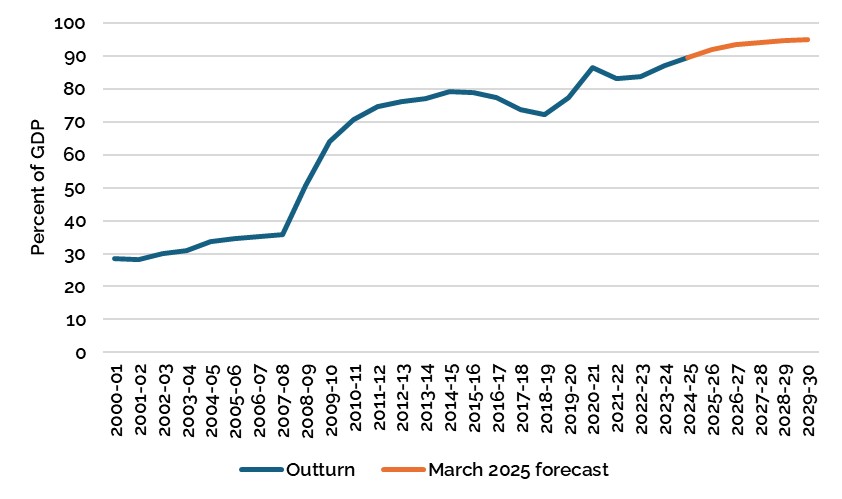
The UK now has debt-to-GDP of 95% and this has risen substantially since the 2007-2008 financial crisis and then the pandemic. Despite repeated official forecasts showing the path of debt-to-GDP falling in future years, it has simply kept rising.
Fig 1. Public sector net debt – actual and forecast
Source: OBR Fiscal risks and sustainability report 2025
Fig 2. Upward revisions to net debt forecasts

Source: OBR Fiscal risks and sustainability report 2025
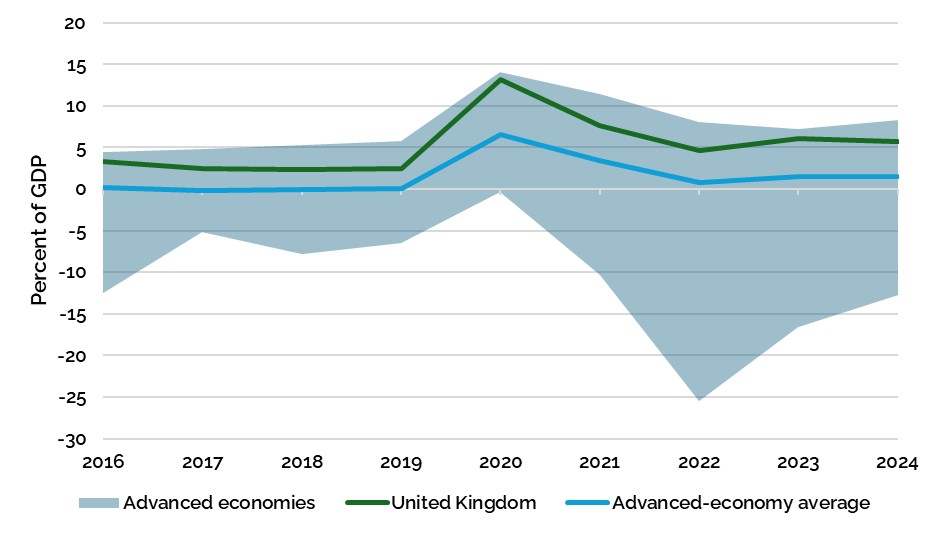
Debt interest spending is expected to be £111bn in 2025-26 equivalent to 3.7% of GDP. For context, that’s over three times the amount spent on adult social care. At the end of 2024, the UK government’s deficit was 5.7% of GDP – 4 percentage points higher than the advanced economy average. This reflects a trend, particularly visible since the pandemic, of the UK borrowing more as a share of GDP than peer countries.
Fig 3. Government borrowing in advanced economies since 2016
Source: OBR Fiscal risks and sustainability report 2025
For these reasons, while specific elements of UK government spending appear affordable in isolation – for example, state pension and healthcare spending are lower in the UK than in many comparable countries as a proportion of GDP – any future spending increases pose substantial risks to fiscal sustainability against this backdrop of high debt, a large deficit and sizeable interest payments. In a recent report, NIESR forecast a budget deficit of £41.2bn by the Autumn Budget in the absence of any further policy changes – which would blast a gaping hole through the fiscal rules.[2]
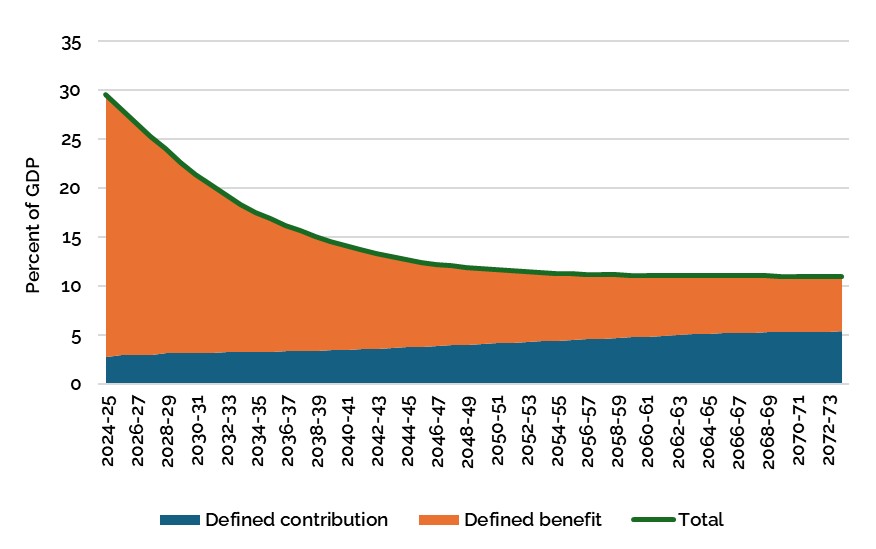
The changing nature of pensions will also affect debt sustainability over the medium term, as the shift from defined-benefit to defined-contribution will likely see an exodus from gilts, further increasing the government’s interest payments as demand for government debt falls.
Fig 4. Projected pensions sector gilt holdings
Source: OBR Fiscal risks and sustainability report 2025
Austerity 2.0? Tax rises, public spending squeeze – or both?
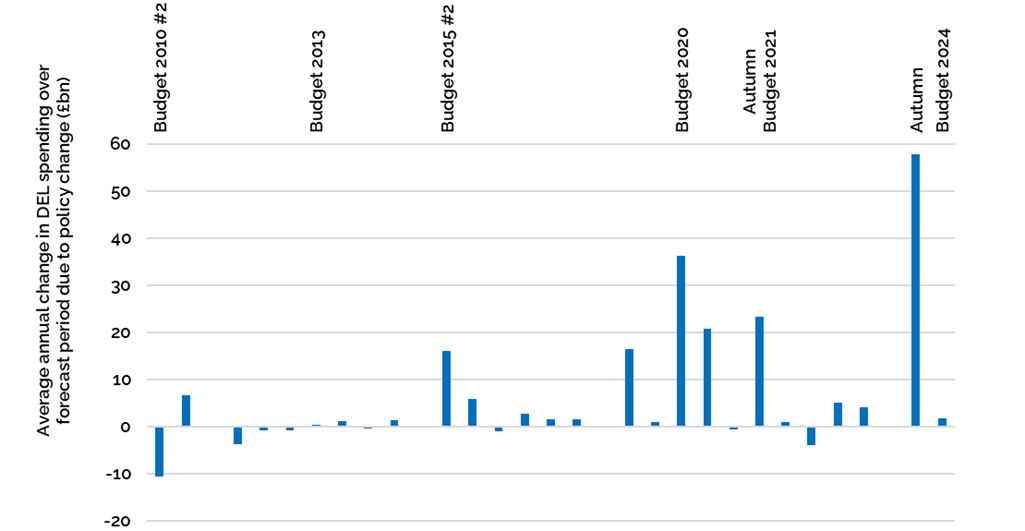
Labour backbenchers may want increased spending and investment to boost ailing public services, but, given the fiscal situation, this is not possible without tax rises. The substantial spending rise in the 2024 Autumn Budget – £69.5bn, or 2.2% of GDP by 2029–30 – was a trick that cannot be repeated, at least not without inviting comparisons to the short-lived Truss administration. Half of the increase in spending in autumn 2024 was funded through extra borrowing in, as the OBR put it, “one of the largest fiscal loosenings of any fiscal event in recent decades”. Those spending increases were important – particularly in signalling a long-overdue boost to the UK’s creaking infrastructure – but given current borrowing costs and debt levels, the Chancellor knows only one such spending hike is possible this Parliament.
Fig 5. Changes to spending plans at fiscal events
Source: OBR Fiscal risks and sustainability report 2025
Yet demands for spending will continue to be unrelenting given the existing state of public services, increasing and complex demands on the healthcare system, and the political power of older people as the row and eventual policy reversal over the winter fuel allowance shows.
Something’s got to give – either we raise the main taxation levers, which would break a manifesto pledge, reduce spending further for non-ringfenced departments that have been cut to the bone, or we increase UK debt, further spooking markets. None are attractive options.
Moving beyond paralysis to delivery
A programme of public service reform to support prevention, while mobilising civil society and communities will be critical to charting a positive path forward against the likely tide of tax rises and spending cuts down the track.
This won’t be easy, but there are glimmers of a more proactive approach:
- The government’s devolution agenda offers strategic authorities the chance to shape services more effectively locally.
- The industrial strategy has the potential to harness more private capital for high-productivity local and regional clusters.
- The NHS’s vision for neighbourhood health services offers a promising model for prevention and early intervention.
- There’s an opportunity to revive elements of Labour’s 2000s model – the New Deal for Communities – through the planned seed funding for new hyperlocal initiatives such as youth clubs, family hubs and safe green spaces.
But all these intentions must now be backed by delivery.
For the next year, as strange as it may sound, the government should focus less on the next General Election and more on delivery, delivery, delivery - particularly of the preventative state. This was a potentially powerful frame during Labour’s time in opposition. Now, it must become a governing mission.
If Labour can show meaningful progress against adversity, it will have a powerful narrative to take into the 2029–30 election – and a stronger chance of heading off the populist threat.
Declaration: ILC has used AI tools solely to check spelling, punctuation and grammar in this article.
[1] https://obr.uk/frs/fiscal-risks-and-sustainability-july-2025/
[2] https://niesr.ac.uk/publications/uk-economic-outlook-chancellors-trilemma?type=uk-economic-outlook
Ben Franklin
Deputy Chief Executive
Ben oversees major policy projects and programmes of work for ILC. He is an expert on the intersection of economic and social policy and previously ran the think tank Centre for Progressive Policy, doing ground breaking work on spatial inequality and inclusive growth.
As well as working in think tanks, Ben has worked in the Treasury, Financial Conduct Authority and in the insurance industry.
