
- ABOUT
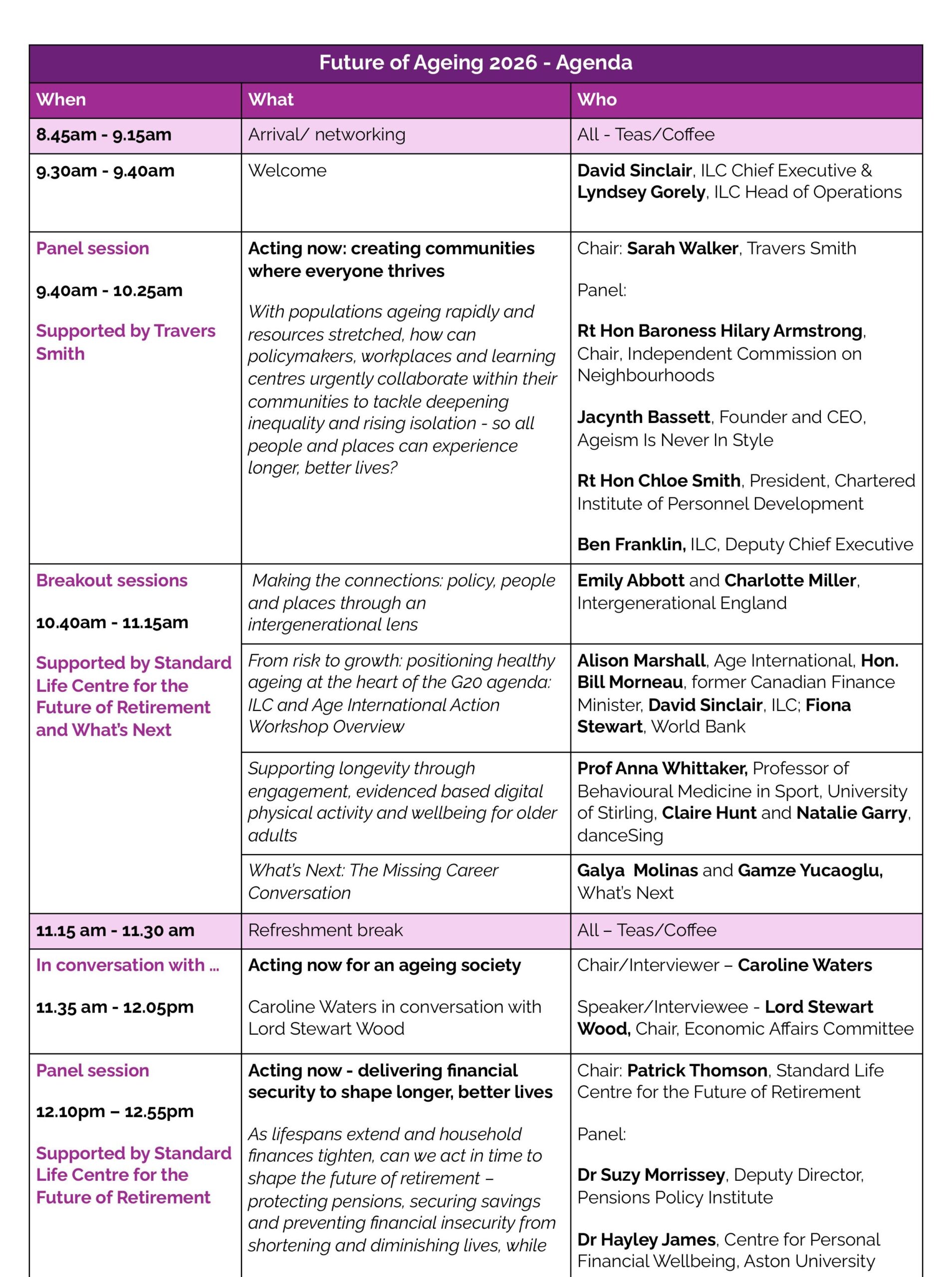
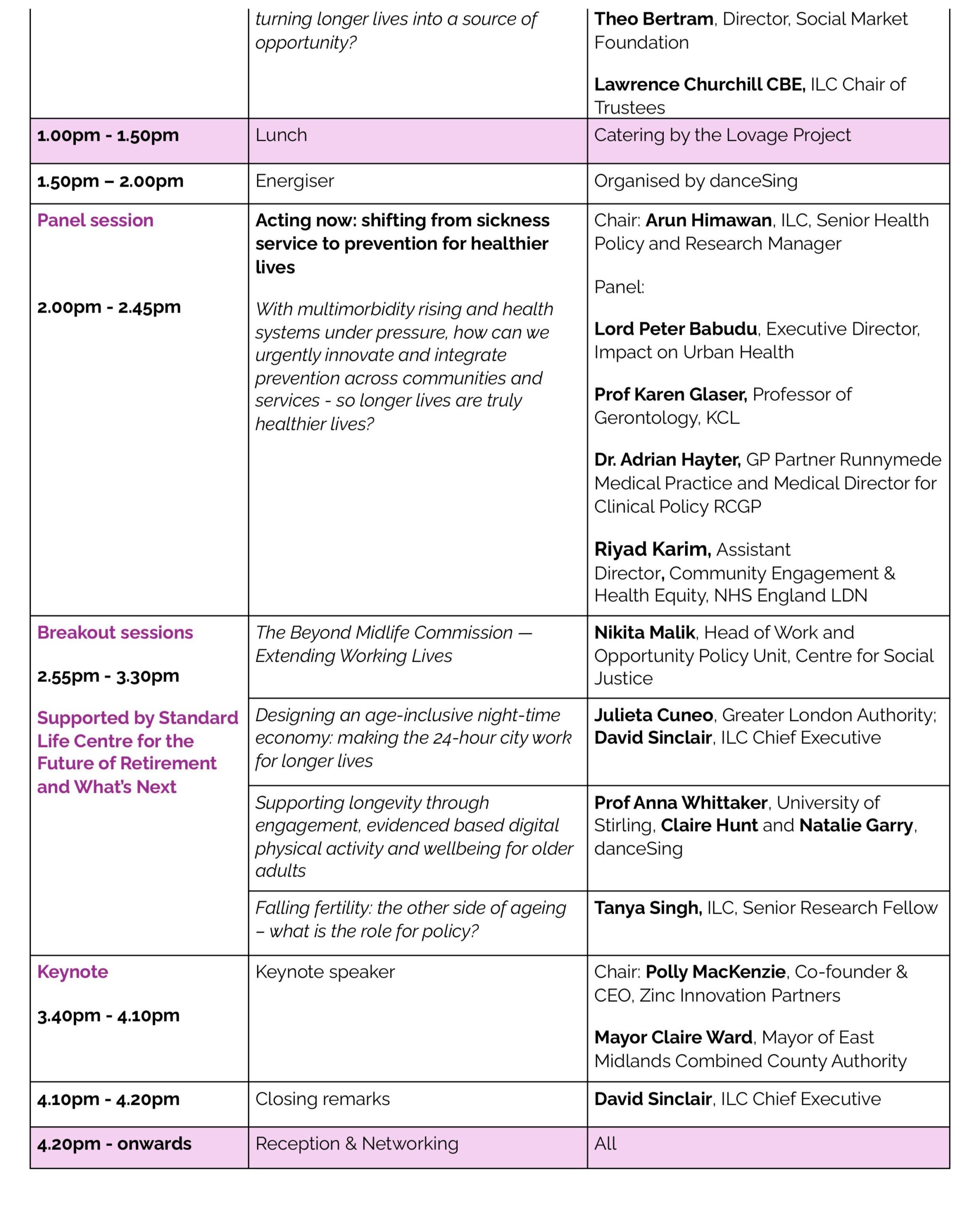
- AGENDA
- SESSION SUMMARIES
- PLENARY SESSIONS
- BREAKOUT SESSIONS
- CONFIRMED SPEAKERS
- SPEAKER BIOGRAPHIES
- SPONSORS
- GET IN TOUCH
Thursday 5 March 2026
The Foundry, 17 Oval Way, London SE11 5RR
About
On Thursday, 5 March 2026, ILC brought together policymakers, business leaders, innovators, and researchers to set out a new agenda for urgent action exploring how nations, regions and communities can act now to embrace the opportunities of long lives.
Population ageing is no distant issue. It is both a seismic challenge and a huge opportunity we must confront today. Rising health and pension costs, alongside mounting national debt, make the status quo unsustainable. But healthier, longer working lives could deliver a powerful economic dividend. With advanced economies searching for supply-side growth, acting now on ageing is not optional. It is essential.
These discussions were underpinned by our new UK Better Lives Index, exploring the best and worst places to be born, grow up, and grow old across the UK, and our Global Health and Prevention Index, our flagship international barometer of healthy ageing.
Sponsored by:


Acting now: creating communities where everyone thrives
With populations ageing rapidly and resources stretched, how can policymakers, workplaces and learning centres urgently collaborate within their communities to tackle deepening inequality and rising isolation - so all people and places can experience longer, better lives?
Chair: Sarah Walker, Travers Smith
Panel: Rt Hon Baroness Hilary Armstrong, Chair, Independent Commission on Neighbourhoods Jacynth Bassett, Founder and CEO, Ageism Is Never In Style Rt Hon Chloe Smith, President, Chartered Institute of Personnel Development Ben Franklin, ILC, Deputy Chief Executive
Session kindly supported by Travers Smith.
The recording below is not of the highest quality but you can download transcript of the session here.
Acting now for an ageing society
Caroline Waters OBE sits down with Lord Stewart Wood, Chair of the House of Lords Economic Affairs Committee, to discuss one of the most pressing – and often overlooked – issues facing the UK: how prepared we really are for an ageing society.
The recording below is not of the highest quality but you can download transcript of the session here.
Acting now - delivering financial security to shape longer, better lives
As lifespans extend and household finances tighten, can we act in time to shape the future of retirement – protecting pensions, securing savings and preventing financial insecurity from shortening and diminishing lives, while turning longer lives into a source of opportunity?
Chair: Patrick Thomson, Standard Life Centre for the Future of Retirement
Panel: Dr Suzy Morrissey, Deputy Director, Pensions Policy Institute Dr Hayley James, Centre for Personal Financial Wellbeing, Aston University Theo Bertram, Director, Social Market Foundation Lawrence Churchill CBE, ILC Chair of Trustees
Session kindly supported by the Standard Life Centre for the Future of Retirement.
The recording below is not of the highest quality but you can download transcript of the session here.
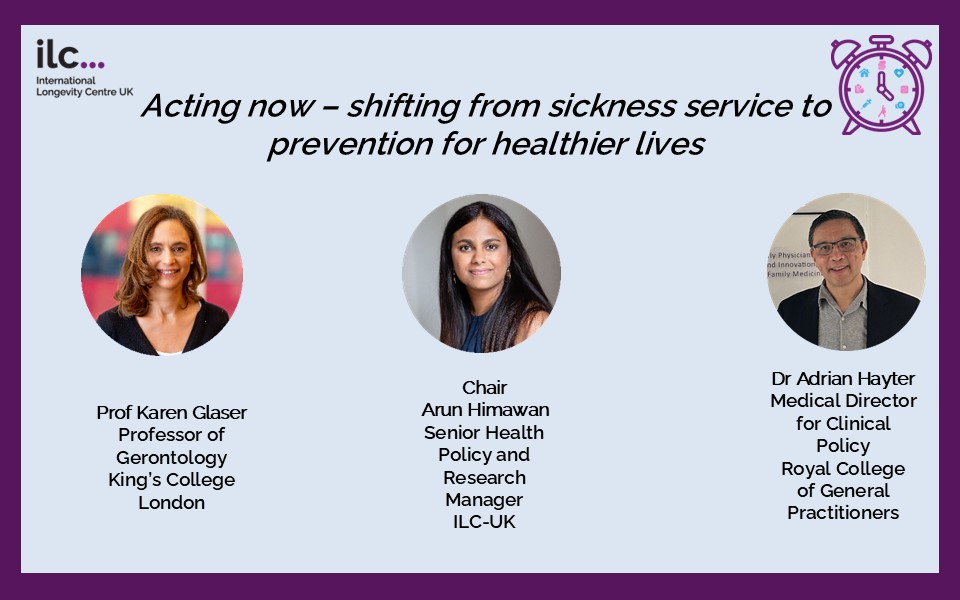
Acting now: shifting from sickness service to prevention for healthier lives
With multimorbidity rising and health systems under pressure, how can we urgently innovate and integrate prevention across communities and services - so longer lives are truly healthier lives?
Chair: Arun Himawan, ILC, Senior Health Policy and Research Manager
Panel: Prof Karen Glaser, Professor of Gerontology, KCL and Dr. Adrian Hayter, GP Partner Runnymede Medical Practice and Medical Director for Clinical Policy RCGP
Download transcript of the session here.
Plenary sessions
Acting now: creating communities where everyone thrives
With populations ageing rapidly and resources stretched, how can policymakers, workplaces and learning centres urgently collaborate within their communities to tackle deepening inequality and rising isolation - so all people and places can experience longer, better lives?
Acting now - delivering financial security to shape longer, better lives
As lifespans extend and household finances tighten, can we act in time to shape the future of retirement – protecting pensions, securing savings and preventing financial insecurity from shortening and diminishing lives, while turning longer lives into a source of opportunity?
Panel Session: Acting now: shifting from sickness service to prevention for healthier lives
With multimorbidity rising and health systems under pressure, how can we urgently innovate and integrate prevention across communities and services – so longer lives are truly healthier lives?
Breakout sessions
Morning sessions
1. What’s Next: The Missing Career Conversation: What's Next, Galya Molinas and Gamze Yucaoglu
We are living longer than any generation before us; yet we neglect talking about how to design meaningful, multistage working lives across decades.
In this research-informed and interactive session, we explore the structural gap between extended lifespans and outdated career models, drawing on leading longevity and workforce research. Participants will be invited into a short, facilitated exercise that offers a taste of the roadmap behind our workshops and forthcoming book.
Join us for a thoughtful and practical conversation about the future of work in the age of longevity and what might come next.
2. From risk to growth: positioning healthy ageing at the heart of the G20 agenda: ILC and Age International Action Workshop – Alison Marshall, Age International, Hon. Bill Morneau, former Canadian Finance Minister, David Sinclair, ILC; Fiona Stewart, World Bank
As the UK prepares to take on the G20 presidency, this workshop examines how that moment of influence can be used to reframe ageing as a driver of economic growth and resilience. Across the G20, longer lives are too often treated primarily as a fiscal challenge rather than recognised for what they can enable – higher labour market participation, stronger productivity and more sustainable public finances when supported by the right mix of skills policy, technology adoption, inclusive labour markets and financial systems.
3. Making the connections: policy, people and places through an intergenerational lens: Intergenerational England - Emily Abbott and Charlotte Miller
We will explore how this lens can:
• Reshape how we plan and design the built environment
• Influence health, housing and social policy
• Strengthen social relationships across generations
• Shift systems to prioritise belonging, equity and participation
Drawing on international examples of intergenerational action, participants will discover practical ways to apply this approach in their own context. Through interactive reflection, we’ll ask: where do you sit in the system and what change can you make from there?
Join us to explore a new way of looking at ageing, one that sees every generation not in isolation, but as part of a shared future.
4. Supporting longevity through engagement, evidenced based digital physical activity and wellbeing: danceSing - Professor Anna Whittaker, University of Stirling, Claire Hunt and Natalie Garry, danceSing
Afternoon sessions
1. Designing an age-inclusive night-time economy: making the 24-hour city work for longer lives: David Sinclair, ILC, Juliet Cuneo, GLA
This session brings together national and city perspectives to explore how cities can harness demographic change, improve accessibility, reduce barriers and design night-time economies that work for ageing populations as well as for the wider community.
This interactive workshop explores how cities can redesign the night-time economy to reflect longer lives and changing demographics. Drawing on national and city-level experience, it will focus on the practical actions needed now to create night-time environments that are accessible, inclusive and economically resilient for all ages.
2. The Beyond Midlife Commission — Extending Working Lives - Centre for Social Justice, Nikita Malik
This session, hosted by the Centre for Social Justice (CSJ) will focus on one of the most pressing and yet underexamined challenges facing our country: how we support people approaching midlife and beyond to thrive in the labour market. As of this year, almost one in five people in England are now aged 65 and over, and nearly two in five are aged 50 and over. Yet too many people in this stage of life face barriers to good work, financial security, and wellbeing, when they still have so much to contribute.
Ensuring that this group of workers continue to make an essential contribution to our economy as workers, carers, taxpayers, and volunteers is an important issue for public policy, and one will this project will seek to address. This talk will share early data and analysis from the BMC, as well as anticipated outcomes and policy recommendations.
3. Falling fertility: the other side of Ageing - what is the role for policy? - Tanya Singh, Senior Research Fellow, ILC
Across the UK, birth rates have been trending down for more than a decade, and this is increasingly shaping how we think about ageing, future workforce capacity, and pressures on public services. At the same time, evidence suggests many people still want children, but feel unable to start or grow their families in the way they hoped. That gap raises a practical question: is falling fertility mostly a reflection of changing preferences, or of barriers and trade-offs that policy could reduce?
This breakout is designed as an open, discussion-led session. Participants will be encouraged to weigh up whether falling fertility is something governments should treat as a policy issue at all — and what principles should guide any response. Together, we’ll explore what “supporting choice” could mean in practice: which barriers policy might realistically reduce (and for whom), what would be ineffective or counterproductive, and where the lines are between enabling, incentivising, and intruding.
4. Supporting longevity through engagement, evidenced based digital physical activity and wellbeing: danceSing - Professor Anna Whittaker, University of Stirling, Claire Hunt and Natalie Garry, danceSing
Confirmed speakers
We are delighted to confirm that the following speakers will be joining us for Future of Ageing 2026: Acting now- delivering longer, better lives for all:
- Lord Wood of Anfield, Chair of the House of Lords Economic Affairs Committee
- Rt Hon Baroness Hilary Armstrong, Chair of the Independent Commission on Neighbourhoods
- Baron Peter Babudu, Executive Director of Impact on Urban Health
- Jacynth Bassett, Founder and CEO of Ageism Is Never In Style
- Theo Bertram, Director, SMF
- Ben Franklin, Deputy Chief Executive, ILC-UK
- Professor Karen Glaser, Professor of Gerontology, King's College London
- Dr Adrian Hayter, GP Partner Runnymede Medical Practice and Medical Director For Clinical Policy RCGP
- Dr Hayley James, Senior Research Fellow, Centre for Personal Financial Wellbeing, Aston University
- Riyad Karim, Assistant Director, Community Engagement & Health Equity, NHS England LDN
- Polly Mackenzie, Co-founder and CEO, Zinc Innovation Partners
- Hon. Bill Morneau, former Canadian Finance Minister
- Dr Suzy Morrissey FCA, Deputy Director, Pensions Policy Institute
- Rt Hon Chloe Smith, President, CIPD
- Mayor Claire Ward, Mayor of the East Midlands Combined County Authority
Acting now: creating communities where everyone thrives
Chair: Sarah Walker, Partner, Travers Smith
Sarah is a partner at Traver Smiths Real Estate team with a particular focus on the investment into, and development of, non-core real estate assets.
Sarah has a particular focus and considerable experience in the investment into and development of housing and healthcare for older people acting for investors, developers and operators, such as long-standing clients Care REIT plc (formerly Impact REIT) and McCarthy Stone.
Sarah has a genuine and keen interest in the decarbonisation of the built environment through active asset management and, more broadly, impact investing, leading on ESG within the real estate team at Travers Smith. She is a member of various ESG committees within Travers Smith and sits on the AREF D&I Working Group Committee focusing on capturing and benchmarking industry standards.
Rt Hon Baroness Hilary Armstrong, Chair, Independent Commission on Neighbourhoods
Baroness Armstrong was a Cabinet minister in the Labour Government from 2001 to 2007. She was also Minister for Local Government and Minister for Social Exclusion during her time in office. A Member of Parliament from 1987 to 2010, she represented the seat of North West Durham. Armstrong worked as a social worker and university lecturer before entering politics. During her time in office, she was responsible for many major government initiatives, including the New Deal for Communities, one of the most successful regeneration initiatives by government in recent times.
Jacynth Bassett, Founder and CEO, Ageism Is Never In Style
Jacynth Bassett is a globally recognised expert, consultant, and keynote speaker on age inclusivity, longevity, and intergenerational strategy. She is the Founder and CEO of Ageism Is Never In Style®, the leading award-winning global consultancy and platform driving business and cultural change by reshaping how organisations and society engages with ageing, generations, longevity and life stages.
Sitting at the intersection of culture, commerce, and strategy, Jacynth is widely regarded as one of the most distinctive, actionable, and commercially driven voices shaping the global age-inclusivity, longevity and intergenerational agenda. Through a holistic approach spanning strategy, talent, market intelligence, and culture, she helps organisations eradicate age bias, and move beyond siloed thinking to build age-inclusive, intergenerational and longevity systems that enable retention, productivity, collaboration, relevance, and long-term growth.
Ben Franklin, Deputy Chief Executive, ILC
Ben oversees major policy projects and programmes of work for ILC. He is an expert on the intersection of economic and social policy and previously ran the think tank Centre for Progressive Policy, doing groundbreaking work on spatial inequality and inclusive growth.
He has advised national and local leaders on how to address the drivers of economic inequality, and his work has been featured across all national news outlets.
Ben has specific expertise in the economic impacts of demographic change, having led research projects on older workers, retirement income adequacy and the macroeconomic impacts of ageing in a previous stint at ILC. As well as working in think tanks, Ben has worked in the Treasury, Financial Conduct Authority and in the insurance industry.
Rt Hon Chloe Smith, President, Chartered Institute for Personnel and Development
Rt Hon Chloe Smith is a senior leader with expertise in technological change, workforce transformation and skills, global economics, regulation, risk and governance. She uses her experience, insight and network to help organisations to navigate these challenges. Chloe is passionate about people and technology.
As a Cabinet minister, she built and led the new government department for Science, Innovation and Technology. She provides insight into the global economy, labour market, pensions, health and productivity and the future of work from her service as Secretary of State for Work and Pensions and Minister for Disabled People, Health and Work.
Acting now - delivering financial security to shape longer, better lives
Chair: Patrick Thomson, Head of Research Analysis and Policy, Standard Life Centre for the Future of Retirement
Patrick leads policy and research for the Standard Life Centre, exploring the changing way that people save, work and retire. He has nearly 20 years experience of policy, research, and delivery in government, the private sector, and a What Works Centre. He previously led the Centre for Ageing Better’s programme on age-inclusive employment, has been an expert witness to Select Committees, and authored a review of the case for longer working lives for the Intergenerational Commission.
As a former member of the Government Social Research Unit he managed a research, policy and analysis portfolio for the Department for Work and Pensions’ ageing society and extending working lives strategy, and helped produce the evidence base which led to the removal of the Default Retirement Age in 2011.
Theo Bertram, Director, Social Market Foundation
Theo Bertram studied at the University of Cambridge before completing a PhD on Samuel Beckett at the University of Bristol. After leaving Downing Street in 2010, Bertram worked as Head of Public Affairs at Telefonica O2 UK before joining Google, where he worked on a range of UK and European public policy issues for eight years. In 2019, he joined TikTok, where he was Vice President for Public Policy and Government Relations, focused on European and global technology public policy issues and engaging with global institutions on behalf of TikTok.
He started his career in politics as a regional organiser for the Labour Party and rose through the ranks to become a Special Adviser in Downing Street to Prime Minister Tony Blair in 2006. He was one of the few advisers to serve both Blair and Gordon Brown, becoming Head of Research and Information at No. 10.
Dr Hayley James, Senior Research Fellow, Centre for Personal Financially Wellbeing, Aston University
Hayley is a Senior Research Fellow at the Centre for Personal Financially Wellbeing, Aston University. She has extensive research experience on pension policy and pension saving behaviours, including her recently published book 'Pension Saving in a Gendered Lifecourse'. She has recently completed a British Academy Innovation Fellowship on Real Accounts, a ten-month financial diaries study which followed households on low to medium incomes.
Dr Suzy Morrissey FCA, Deputy Director, Pensions Policy Institute
Suzy is the Deputy Director of the Pensions Policy Institute where she is responsible for the PPI work programme and manages the policy research and modelling teams. Suzy was recently appointed by the Secretary of State for Work and Pensions to be the Independent Reviewer for the third State Pension Age Review.
Suzy's career includes experience in both the public and private sectors. She started her career working for global consulting firms in Australia and New Zealand. She then moved to the public sector and held several senior positions in the New Zealand civil service, including at Treasury and the Retirement Commission, before recently returning to the UK. In 2018, Suzy was conferred Fellowship (FCA) by Chartered Accountants Australia and New Zealand, in recognition of her outstanding contribution to the profession.
Acting now: shifting from sickness service to prevention for healthier lives
Chair: Arun Himawan, Senior Health Policy and Research Manager, ILC UK
Arunima Himawan is the Senior Health Policy and Research Manager at ILC. Arun heads ILC’s Global Health Programme, which includes the organisation’s flagship global Healthy Ageing and Prevention Index. Her background is in global health and social epidemiology, and has particular expertise in life course immunisation, NCDs, system strengthening, health inequity and convening high-level policy forums alongside multilateral meetings. She sits on the Steering Committee of the EU Structural Heart Disease Coalition, the EU Steering Group on Prevention of Respiratory Infections and is a member of ILC-Global Alliance Gender and Ageing Committee and ILC-Global Alliance International Committee.
Lord Peter Babudu, Executive Director, Impact on Urban Health
Peter has been the Director for Impact on Urban Health since 2023. He brings together Impact on Urban Healths programmes’ funding and partnerships, as well as the work of their data, evidence and innovation teams in support of our urban health work. Peter brings a range of experience in senior leadership roles, in organisations including the Youth Endowment Fund and The Social Innovation Partnership. He also previously served as a Councillor in Southwark Council and as Chair of Blagrave Trust.
Prof Karen Glaser, Professor of Gerontology, King’s College London
Professor Karen Glaser is a researcher in social gerontology at King’s College London, where she previously served as Director of the Institute of Gerontology. Her research focuses on grandparental care, working lives beyond the state pension age, and long-term care. She currently co-leads the Work and Welfare Programme at the Economic and Social Research Council-funded Centre for Society and Mental Health, investigating the links between mental distress and economic inactivity, and exploring how individuals experiencing mental distress, as well as their carers, can be supported to remain in work.
Her research adopts a life course approach to examine how work and family biographies shape health and well-being in later life. She has conducted cross-national studies on the determinants and consequences of grandparental childcare and explored how welfare regimes influence the roles grandparents play in family support. She led a UK ESRC-funded project on long-term care and inequalities in later life, as part of an international initiative.
Dr. Adrian Hayter, GP Partner Runnymede Medical Practice and Medical Director for Clinical Policy RCGP
Adrian has been a GP for nearly 30 yrs working clinically at the Runnymede Medical Practice as a GP partner.
He held leadership roles at local and national level working in commissioning roles in Primary Care Groups Trusts and as a Chair of a Clinical Commissioning Group for Windsor Ascot and Maidenhead.
In 2019, He was appointed to National Clinical Director for Older People for NHS England (the first GP to hold the role) and lead the Ageing Well Programme supporting national policy for older people through the COVID Pandemic. He sat on the Scientific Advisory Group Emergencies subcom
mittee for people receiving social care and was the non-aged based clinical lead for the vaccination programme leading the Covid vaccination in care home programme.
In 2024. He became the Medical Director for Clinical Policy at the Royal College Of General Practitioners and is responsible for supporting the Clinical Priority for the College which is Preventive Medicine. He is a member of the WHO Clinical Consortium for Healthy Ageing and a lecturer in Gerontology at Singapore University of Social Science.
Riyad Karim, Assistant Director, Community Engagement & Health Equity, NHS England London
Riyad leads region-wide efforts to advance vaccine equity through inclusive, community-driven approaches that engage underserved populations. He pioneered the nationally recognised 3Ts model—Trusted Leaders, Trusted Places, Trusted Voices—which has reshaped how the NHS connects with communities across London, including Bangladeshi, Pakistani, Somali, Black African and Caribbean, Eastern European, Brazilian, and Portuguese-speaking populations.
His approach brings together trusted community and faith leaders with public health and NHS teams at place, system, and regional levels to improve vaccine and screening uptake, promote broader health and wellbeing, and build lasting trust through culturally grounded, community-centred engagement.
Sponsors
We're grateful to our sponsors for funding Future of Ageing 2026: Acting now- delivering longer, better lives for all.
If you're interested in sponsoring next year's conference, get in touch with Patrick Swain.
We want to hear from you
If you would like to find out more about Future of Ageing 2026, please contact Hope Scott.