Countries can boost life expectancy by up to 3 years by investing more in prevention
20 May, 2025
New research by the International Longevity Centre UK (ILC), finds that spending more on preventative health interventions – including vaccination, screening and management of conditions – can boost life expectancy by up to 3 years. This comes after ILC’s Healthy Ageing and Prevention Index highlighted that post-pandemic life expectancy across the world had fallen by an average of 8 months between 2019 and 2022.
As global health leaders come together this week in Geneva as part of the 78th World Health Assembly, ILC urge politicians to invest not only in health, but particularly in preventative interventions, like vaccination, screening and management of conditions, to reverse this worrying trend. This is in line with the UN’s goals of achieving universal health coverage for all by 2030, and the UK’s current focus on creating an NHS ‘fit for the future’.
As part of this, it is vital for policymakers to consider the underlying determinants of poor health – such as age, sex, gender, ethnicity and disability – and to properly target interventions accordingly.
Modelling based on ILC’s Index, bringing together data on 153 countries across the world, finds that life expectancy is almost entirely a product of healthcare spending but the ratio of spend on prevention adds vital years to people’s lives. Germany spends the most per person ($664) on prevention across the world meaning an additional 3-year boost to the average life expectancy of its people as a result. (i.e. Germany has an average life expectancy of 81 years rather than 78 years.)
Projecting life expectancy as a function of health spend and prevention spend, compared to actual life expectancy

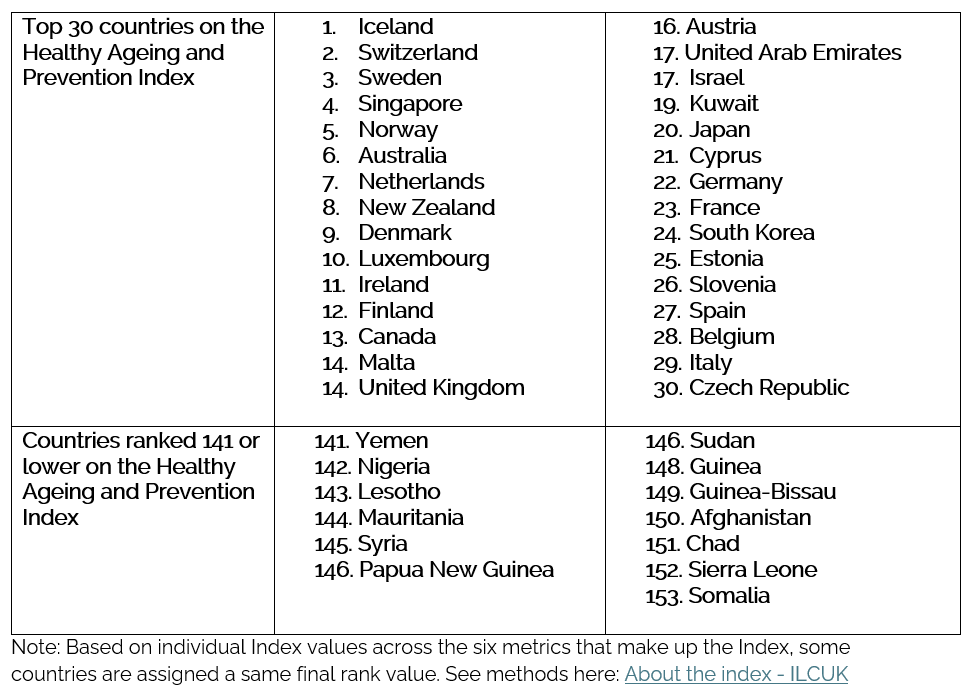
In some lower-income countries, foreign aid and NGO activities are not captured as part of government healthcare budgets. This “low-income effect” contributes a year or more to predicted life expectancy, highlighting the crucial role for these players. In countries ranked 141 or lower on the Healthy Ageing and Prevention Index, the predicted life expectancy based on healthcare and preventative spend starts going off-track because of conflict or humanitarian crises minimising actual life expectancy gains.
These new findings, launched at a side event to the World Health Assembly, highlights the key role prevention plays in boosting life expectancy. ILC urge global health leaders to redouble efforts in health. For high-income countries this means investing as much as Germany (7.8% of their healthcare budget) on prevention to support people to live healthier long lives. For low-income countries, the focus must be on increasing per capita spend on both healthcare and prevention. Keeping people healthier drives economic returns too. Previous ILC research found that a 0.1 percentage point increase in prevention spend can boost spending by people aged 60+ by 9%.
Arunima Himawan, Senior Health Policy and Research Manager and lead of the Healthy Ageing and Prevention Index said:
“Life expectancy is the fundamental measure of whether a country is healthy. Our analysis shows that investing in healthcare is crucial but so is prevention. Yet we continue to see countries failing to invest in what works. With the 2030 deadline for the implementation of the Sustainable Development Goals fast approaching, we’re off-track to meet all the health targets. This should be a wake-up call for governments to realise that their current approach isn’t enough, particularly as populations age, and they should start investing their money wisely and on what can have the greatest impact on population health.”
Peter Baker, Director, Global Action on Men’s Health argued:
“Sex and gender are major determinants of health outcomes, including life expectancy, and must be taken fully into account by policymakers and service providers. Men in particular experience premature mortality as a result of a range of preventable physical and mental health problems, including cardiovascular disease, cancer and suicide. A strategic approach to men’s health, with a particular focus on prevention and early diagnosis, is well overdue This must include improving men’s access to a range of primary care and screening services. It could add vital years to men’s lives across the world.”
Ends
Contact
Press@ilcuk.org.uk Spokespeople are available on request.
Notes
You can access the Healthy Ageing and Prevention Index here. See methods here: About the index - ILCUK
ILC will launch these findings alongside the World Health Assembly – for more details see here. The in-person event is now full but you can register on zoom here.
The latest available figures show that Germany spends the most per person ($664 - 7.8% of their healthcare budget in 2022) on prevention across the world meaning an additional 3-year boost to the average life expectancy of its people as a result. i.e. Germany has an average life expectancy of 81 years rather than 78 years.
About ILC
ILC is the UK’s leading authority on the impact of longevity on society. We combine evidence, solutions and networks to make change happen.
We help governments, policymakers, businesses and employers develop and implement solutions to ensure we all live happier, healthier and more fulfilling lives.
We want a society where tomorrow is better than today and where future generations are better off. ILC wants to help forge a new vision for the 100-year life where everyone has the opportunity to learn across our lives and where new technology helps us contribute more to society.
Global Action on Men’s Health
GAMH’s mission is to create a world where all men and boys have the opportunity to achieve the best possible health and wellbeing wherever they live and whatever their backgrounds.
Global Action on Men’s Health (GAMH) was established in 2013, launched during International Men’s Health Week in June 2014 and registered as a UK-based charity in May 2018. It is a collaborative project that brings together men’s health organisations, and others which share their objectives, in a new global network.