
Healthy ageing and NHS sustainability. Can the UK manage its way out of increasing health costs?
11 May, 2026
The UK spends around a third of what the US does on healthcare per person – but that gap masks a system under severe strain. Drawing on ILC's research on healthy ageing and prevention, David Sinclair argues that lower spending is not the same as efficiency, and asks what it would actually take to build a health system that keeps us healthier as we age – rather than simply managing the consequences of failing to do so.
I recently came across a statistic on U.S. healthcare spending: it reached $5.3 trillion in 2024, driven by rising prices and the intensity of hospital care, doctors’ visits and prescription drugs. That equates to roughly $15,000–$16,000 per person per year, based on a population of around 335 million.
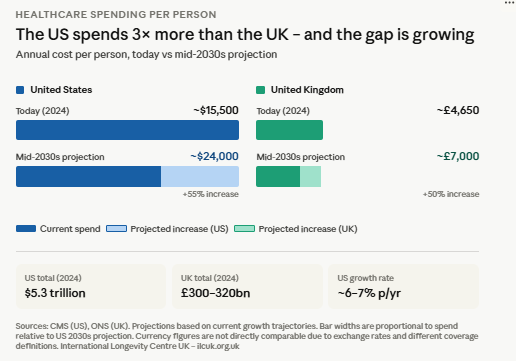
U.S. health spending has been rising at approximately 6–7% per year in nominal terms, implying a doubling roughly every 10–12 years. As we age, we account for a disproportionate share of spending, so by the mid-2030s the cost per person could plausibly reach $22,000–$26,000 per year if current trends continue. And despite this level of spending, outcomes aren't necessarily great. On our Healthy Ageing and Prevention Index, the US comes 38th for Life Expectancy, 61st for Healthy life expectancy. It's no surprise that its 79th in the world when looking at it's work span.
By comparison, total UK healthcare spending is around £300–£320 billion (ONS definition, broader than the NHS alone), with a population of roughly 67–68 million. This implies a per capita cost of around £4,500–£4,800 – approximately one-third of U.S. levels.
Looking ahead, UK health spending could rise to around £450–£520 billion by the mid-2030s, equivalent to roughly £6,500–£7,500 per person, depending on growth rates.
Although spending growth in the UK is likely to be slower than in the U.S, the system is already capacity-constrained, and a much higher share of health is publicly funded. As a result, pressure will not only manifest as higher spending, but also as longer waiting times, workforce shortages and rising unmet need.
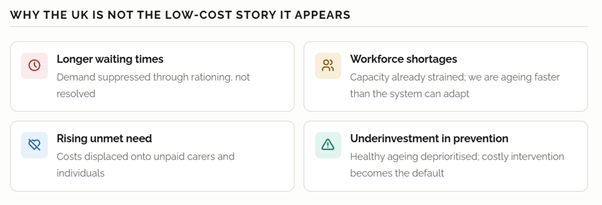
We should therefore be cautious about celebrating lower spending than the US (and high spending in the US isn't driving the results we would expect).
In practice, the UK suppresses costs through rationing and workforce strain, underinvest in prevention and healthy ageing, and shift an increasing burden onto unpaid carers. This is not a low-cost system so much as one where costs are displaced rather than avoided.
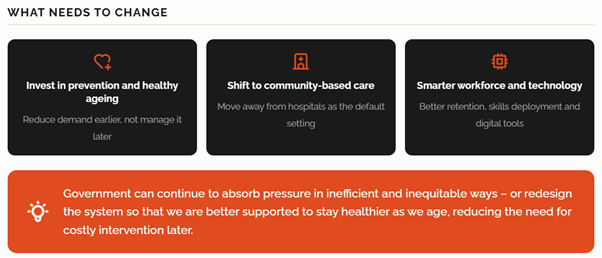
If government is serious about long-term sustainability, it needs to invest earlier in prevention and healthy ageing so that demand is reduced, not simply managed. We also need a credible long-term workforce strategy – better retention, smarter deployment of skills, and far greater use of technology – alongside reform of care delivery, shifting decisively towards community-based and preventative models rather than hospitals as the default.
In short, government can continue to absorb pressure in inefficient and inequitable ways, or redesign the system so that we are better supported to stay healthier as we age – reducing the need for costly intervention later.
David Sinclair
Chief Executive
David has worked in policy and research on ageing and demographic change for over 20 years. He is a recognised expert on longevity, with particular interests in older consumers, active ageing, financial services, adult vaccination and the role of technology in an ageing society.
He has deep knowledge of UK and global ageing issues, spanning health and care, pensions, housing, transport and consumption. David regularly presents internationally on longevity and demographic change and has published widely on topics including transport, technology, health and consumer markets.
David is an international advisor to the Sau Po Centre on Ageing at the University of Hong Kong and a member of the external advisory board for the University of Surrey Centre of Excellence on Ageing. He has worked with the pan-European AGE Platform for 15 years and is a former vice-chair of the government’s Consumer Expert Group for Digital Switchover.
Prior to joining the ILC, David was head of policy at Help the Aged, leading a team of policy advisers, and has held senior policy and public affairs roles across the voluntary sector.
