
Ageing should be a development priority
22 Oct, 2026
David Sinclair, ILC Chief Executive, argues that population ageing is one of the defining development challenges of our era – and that the world’s finance ministers are still not treating it with the urgency it demands. Drawing on a week of events at the IMF–World Bank Annual Meetings in Bangkok, including the World Bank’s launch of its Thailand Country Aging Report and an AARP-convened session on ageing in lower and middle income countries, Sinclair sets out why the transition now under way across Africa, Latin America and Southeast Asia is happening faster and at lower income levels than any previous generation of ageing economies managed. ILC’s own Healthy Ageing and Prevention Index and research on universal health coverage show that the gap between the best and worst-performing countries is vast – and that universal health coverage, not individual lifestyle, is the infrastructure on which healthy ageing depends. With the UK’s G20 Finance Ministers meeting in Edinburgh in July 2027, Sinclair argues that the window to act is narrowing faster than most governments yet appreciate.
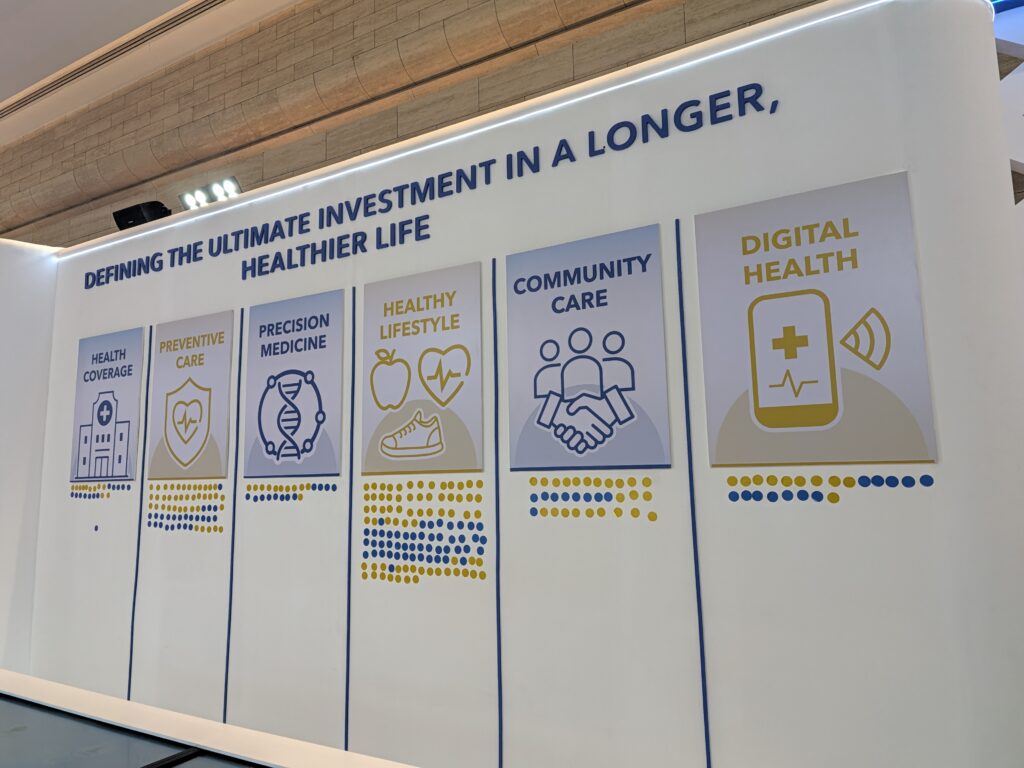
Thailand built a longevity pavilion as part of last week's IMF–World Bank Annual Meetings in Bangkok.
The displays highlighted a country that is ageing faster than its systems can adapt: 400,000 deaths every year from preventable diseases, a care workforce already stretched and set to need 250,000 additional paid home care workers by 2037, and a society in which more than one in five people is already aged 60 or over.
At an event in Bangkok convened by AARP it was pointed out that by 2050, 2.1 billion people will be aged 60 or over. Around 80% of them will live in lower and middle income countries.
Africa – still the world's youngest region – is projected to see a nearly 400% increase in its population aged 60 and over within a generation.
Latin America's share of people over 65 will double in roughly three decades – a shift that took Europe and North America five times as long to navigate.
Thailand will become a super-aged society by 2033, at a far lower income level than Japan, Germany or Italy managed the same transition.
The OECD estimates that GDP per capita could be 40% lower by 2060 without policy adaptation. Research from the Inter-American Development Bank suggests that working just five years longer could offset around half the workforce loss that demographic change would otherwise deliver.
What do we know about Thailand?
The World Bank chose Bangkok to launch its Thailand Country Aging Report. They found that Thailand is not failing because it lacks policies. It has a strong Universal Coverage, community-based care programmes and a strong tradition of health infrastructure.
But it faces is an implementation gap: fragmented institutional responsibilities, siloed agency mandates and insufficient authority where decisions need to be made.
So a lesson was that the challenge for most lower and middle income countries is not that they have no vision for an ageing society. It is that the machinery to deliver it lags behind the demographic reality.
In Thailand only 7% of older Thai people can rely on a pension. Around a third depend on their children; another third must keep working. The average member retiring from Thailand's Government Pension Fund leaves with around $45,000 – roughly $150 a month if they live 25 more years.
NCDs – cancer, cardiovascular disease, diabetes, chronic respiratory conditions – claim around 400,000 lives a year in Thailand alone and cost an estimated 9.7% of GDP to treat.
The global picture
ILC's own Healthy Ageing and Prevention Index tracks 153 countries across life span, health span, work span and other metrics. The data makes the inequality stark: there is a 24-year gap in life expectancy and a 21-year gap in healthy life expectancy between the top and bottom ten countries. Only 1% of the global population lives in countries in the top ten.
The Index also consistently shows that countries which invest more in universal health coverage outperform those that do not – by a significant margin. ILC's research on universal health coverage in lower and middle income countries, supported by Amgen and conducted in partnership with HelpAge International, puts hard numbers on that relationship.
People who live in countries that invest more in universal access to healthcare live on average 16 more years in good health. Countries with universal access to healthcare report half as many deaths per 100,000 as those without.
Over the last two decades, LMICs have made real progress – UHC coverage increased by 60% in that period, reducing the gap with high-income countries by 25%. But high-income countries still outperform LMICs by 22 percentage points, and global progress has stalled since 2015. The number of people paying out of their own pocket for healthcare has risen.
ILC's research brought older adults' own voices into this picture. Speaking with 125 people across Mongolia, Rwanda and Zambia, the barriers they described were concrete and close. A 52-year-old man from Rwanda told ILC researchers: "I had a leg problem that required a metal implant. The doctor asked me why they should bother putting in the implant since I was no longer of any use." That is not a system adapting to long lives.
Do bankers understand the importance of universal health coverage?
In the Bangkok longevity pavilion visitors were invited to vote on which of six investment priorities they would choose: health coverage, preventive care, healthy lifestyle, precision medicine, community care, or digital health. By the end of the week, healthy lifestyle had won by a considerable margin. Health coverage came last.
It is encouraging that prevention won the second most votes. But health coverage finishing last in a room full of finance professionals is a concern.
There is a risk that "healthy lifestyle" becomes a way of attributing health outcomes to individual choices, when the evidence consistently shows that access to care – universal, affordable, continuous – is what determines whether populations age well.
Placing the burden of healthy ageing on individuals rather than systems feels unhelpful. For lower and middle income countries navigating this transition without the fiscal resources of advanced economies, it points policy in the wrong direction.
Where next?
The third wave of ILC's Index publishes in December, comparing outcomes across 153 countries over time.
The UK's G20 presidency brings Finance Ministers to Edinburgh in July 2027. If Edinburgh delivers a serious commitment to demographic change as a fiscal priority – not just a welfare concern, and not just for rich countries – that would be a meaningful step forward.
Demography, as one speaker in Bangkok put it, is not destiny. The choices governments make now will determine whether longer lives are an asset or a liability.
For the world's lower and middle income countries, those choices are more urgent – and the window to make them is narrowing faster than most finance ministers yet appreciate.
David Sinclair
Chief Executive
David has worked in policy and research on ageing and demographic change for over 20 years. He is a recognised expert on longevity, with particular interests in older consumers, active ageing, financial services, adult vaccination and the role of technology in an ageing society. He has deep knowledge of UK and global ageing issues, spanning health and care, pensions, housing, transport and consumption. David regularly presents internationally on longevity and demographic change and has published widely on topics including transport, technology, health and consumer markets. David is an international advisor to the Sau Po Centre on Ageing at the University of Hong Kong and a member of the external advisory board for the University of Surrey Centre of Excellence on Ageing. He has worked with the pan-European AGE Platform for 15 years and is a former vice-chair of the government’s Consumer Expert Group for Digital Switchover. Prior to joining the ILC, David was head of policy at Help the Aged, leading a team of policy advisers, and has held senior policy and public affairs roles across the voluntary sector.
