
Running the numbers
25 Jun, 2026
David Sinclair explores what parkrun's age data tells us about physical activity, ageing and volunteering.
I run parkrun. Badly, and inconsistently - but I enjoy it. I've done 356 of them, mostly at Bognor Regis, over more than a decade. I've watched my times get slower and slower, then - more recently - start to come back.
I’ve wanted to understand the relationship between age and participation for a long time. AI has allowed me to do a bit of analysis that in the past it would have been beyond me.
parkrun, for the uninitiated, began with 13 runners at Bushy Park in Teddington in 2004. It is now a global movement, with more than 360,000 people completing a free, timed 5km on a Saturday across around 2,200 locations in 20 countries.
What can parkrun tell us about ageing and physical activity.
I've been looking at data from Bushy Park - parkrun's original home and still one of its largest events – covering nearly 360,000 runs between 2018 and 2025.
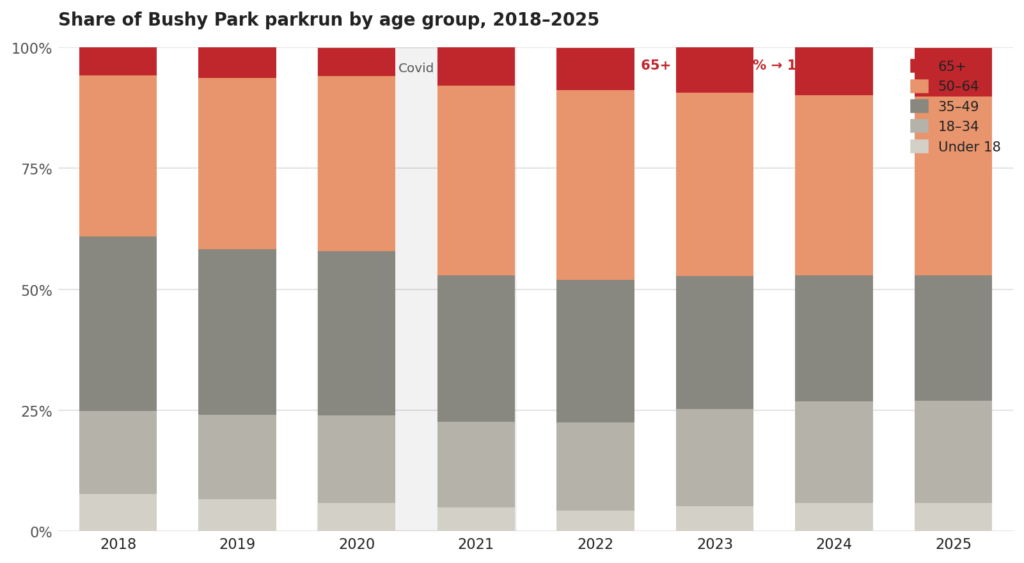
At Bushy over this period, the 50–64 age group accounts for 37% of all runs. That's more than double their share of the UK population (19%).
The 35–49 group also runs above their population share.
But every other group runs below it – and none more so than children and young people. Under-18s make up 21% of the UK population but just 6% of parkrun runs. (there is now a shorter junior parkrun now on a Sunday). The 65+ group, who represent 19% of the population, account for 10% of runs.
There is one group that runs in almost perfect proportion to their population share: 18–34 year-olds. They're 21% of the UK population and 21% of parkrun participants. The assumption that parkrun is failing to attract young adults turns out to be wrong.
So the participation gaps are at the extremes – children and teenagers on one end, and the older among us at the other.
Figure 1: Share of Bushy Park parkrun by age 2018-2025. Source: Bushy Park parkrun data.
A movement that is ageing – and growing
What makes the Bushy data particularly interesting is the trend though. The 65+ share of parkrun participation almost doubled in seven years – from 5.8% of runs in 2018 to 10.1% in 2024–25. In absolute terms, the number of runs by this age group grew from around 2,600 in 2018 to over 7,200 in 2024.
“Six people aged between 90 and 94 completed parkrun at Bushy Park over this period. Their age-adjusted performance is the best of any older age group”.
The 85–89 age group logged 44 runs in 2018. By 2024, that had risen to 158. There are the six individuals in the 90–94 age group – a cohort that didn't register a single run in the dataset before 2021 – who between them had completed 28 parkruns by the data cut-off. Their median finish time was 56 minutes and 44 seconds. Their mean age grade – which adjusts for what is physically possible at that age – is 59.8%, the highest of any over-65 cohort in the dataset.
Older runners are more consistent and they run more regularly
One of the most counterintuitive findings in the data concerns pace consistency. The older the runner, the more consistent their times. Among runners with five or more parkruns, the 65+ group has a coefficient of variation in their finish times of just 7.1% – among the lowest of any cohort, and falling further as age increases. The 85–89 group runs at 4.2% variation. The 90–94 group at 4.1%.
Meanwhile, the 50–64 and 65+ groups run far more regularly than younger participants. At Bushy Park, runners over 50 average ten parkruns each. The 18–34 group averages just 4.6. And among the most committed parkrunners – those with 50 or more runs at Bushy – the 65+ group accounts for 5.7% of its members, compared to just 1.1% of the 18–34 cohort.
Age grade – the metric that adjusts raw finish time for what is physiologically expected at a given age – adds another layer. The 50–64 group achieves the highest mean age grade of any cohort: 57.9%. That outperforms the 18–34 group (53.9%) by four points. Even the 70–74 group, with a median finish time of 34 minutes 22 seconds, has a higher PB rate than the 65–69 group. As we age, we don't stop improving. We just measure improvement differently.
Parkrun runs on older volunteers
The volunteering data may be the most interesting finding. Bognor does relatively well with volunteers although the team has to have a shout out every week. One reason we fill our rota is because we have a small group of older volunteers who fill core roles every week.
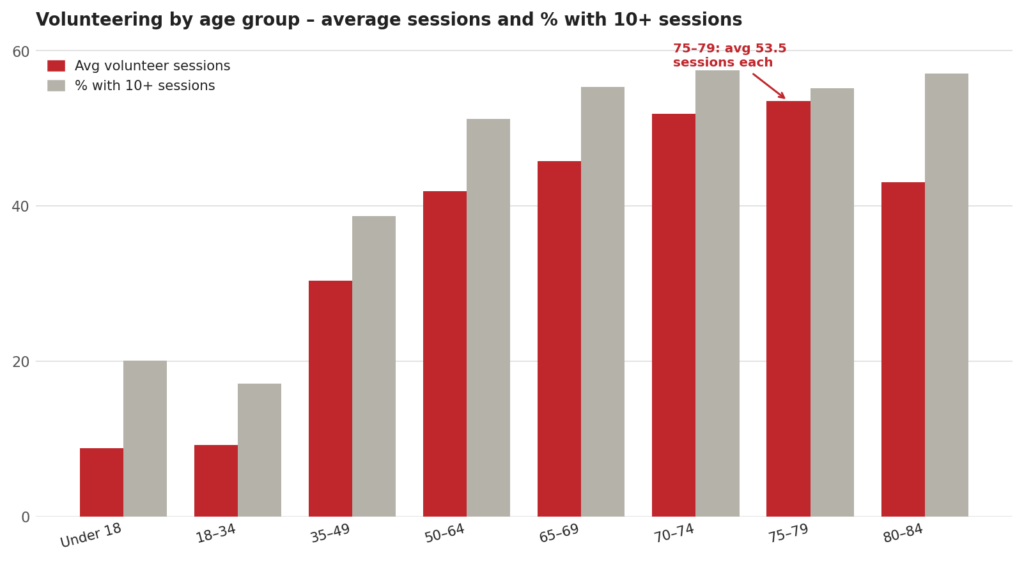
Figure 2: Volunteering by age group – average lifetime sessions and % with 10 or more sessions. Source: Bushy Park parkrun data.
Parkrun is free to enter but it is not free to run. Every event requires a team of volunteers: tail walkers, timekeepers, barcode scanners, marshals, run directors. Without them, there is no parkrun.
So who are the volunteers? The data from Bushy shows that runners in the 65+ age group averaged 50 volunteer sessions each across their parkrun careers – more than five times the 18–34 average of 9.2. Among the 75–79 group, the average rises to 53.5 sessions. Among 80–84 year-olds, 57% have volunteered at least ten times. Among 18–34 year-olds, 61% have never volunteered at all.
And to be clear – I’m not blaming younger people for not doing enough here. There are good reasons why as we get older we might volunteer more. We sometimes need rest days more than we did in our 20s. and we are sometimes former runners. And volunteers do get a lot out of it, including friendship and purpose.
Parkrun is free. It runs on volunteers. And the volunteers are, overwhelmingly, older people – the same group that public discourse so often casts as a burden on society.
Parkrun is keeping us active as we age
Physical activity in the UK follows a depressingly predictable trajectory. Research shows it begins to decline from as early as age six or seven – correlating, in part, with the start of formal schooling. It continues to fall through adolescence. The latest Sport England Active Lives data shows activity levels among 16–34 year-olds remain lower than pre covid levels (2.2% down) even as national averages increases. The overall picture is of a population that moves less and less as it ages.
In some Nordic countries, there is evidence of a modest recovery in leisure-time activity around retirement – driven by walking, skiing, and cycling cultures that are embedded in the fabric of daily life. But that pattern does not reliably appear in UK data. Here, the decline is broadly sustained.
Which makes parkrun's achievement so significant. The growth in over-50 and over-65 participation represents something that public health policy has struggled to achieve through targeted campaigns, behaviour change programmes, and significant public investment: a genuine, sustained increase in physical activity among older age groups, delivered at near-zero cost per participant through a community-led model.
I am not aware of another UK-originated intervention that has achieved comparable results at this scale. Parkrun didn't set out to solve older-age inactivity. It set out to be welcoming, accessible, non-hierarchical, and free. Those qualities attracted everyone – but they particularly attracted people who had been put off by competitive sport, by cost, by the implicit assumption that serious physical activity is for the young.
Even in the rain
As an aside, I wanted to look at whether the weather impacted on participation by age – are some ages more “fair weather” parkrunners.
The data shows the weather barely shifts the age mix at all. Everyone is equally likely to turn up when it's wet. Which is either a testament to stubbornness or to belonging. Probably both.
But what about the sun?
One of the key principles of parkrun - that all events are held in the same place at the same time all year round - has also helped ensure it becomes a "no-brainer" part of people's routines. But in the summer months as we face more and more extreme heat events, the organisers might have to consider earlier starts like they do in parts of Australia, some southern African countries and some states in the USA.
The question parkrun poses for policy
Parkrun is not a public health intervention. It has never claimed to be. But it functions as one.
If a free, non-competitive, community-run Saturday morning event can grow 65+ participation almost twofold in seven years, attract a cohort of dedicated volunteers from among the groups most often overlooked by sports programming, and sustain activity levels in people well into their eighties and nineties – what does that tell us about what works?
It suggests that the design principles matter more than the target group. Parkrun did not set out to be age-friendly. It set out to be welcoming, accessible, non-hierarchical, and free. Those qualities attracted everyone – but they particularly attracted people who had been put off by competitive sport, by cost, by the implicit assumption that serious physical activity is for the young.
Older age groups have historically been treated as low priority for physical activity investment – partly because the return is assumed to be limited, and partly because the mechanisms are poorly understood. Bushy Park's data suggests both assumptions deserve challenge.
The low-hanging fruit for increasing physical activity in Britain may not be the young people who are, in fact, already reasonably well-represented in community running. It may be the generation that has discovered, largely by accident, that parkrun was made for them – and is now running it, volunteering for it, and showing up every Saturday with a consistency the rest of us might aspire to.
David Sinclair is Chief Executive of the International Longevity Centre (ILC), the UK's leading authority on the impact of longevity on society. He has completed 356 parkruns.
References:
There's more information on the UK parkrun website and you can find a map with global start times on the Australian parkrun site here.
Data and analysis:
The analysis in this piece is based on publicly available results data from Bushy Park parkrun, covering 299 events between April 2018 and March 2025 and comprising nearly 360,000 individual runs (https://www.kaggle.com/datasets/jeisonberaun/bushy-parkrun-uk) UK population comparisons use ONS mid-2024 population estimates. Data analysis and visualisations were produced with the assistance of Claude (Anthropic).
David Sinclair
Chief Executive
David has worked in policy and research on ageing and demographic change for over 20 years. He is a recognised expert on longevity, with particular interests in older consumers, active ageing, financial services, adult vaccination and the role of technology in an ageing society.
He has deep knowledge of UK and global ageing issues, spanning health and care, pensions, housing, transport and consumption. David regularly presents internationally on longevity and demographic change and has published widely on topics including transport, technology, health and consumer markets.
David is an international advisor to the Sau Po Centre on Ageing at the University of Hong Kong and a member of the external advisory board for the University of Surrey Centre of Excellence on Ageing. He has worked with the pan-European AGE Platform for 15 years and is a former vice-chair of the government’s Consumer Expert Group for Digital Switchover.
Prior to joining the ILC, David was head of policy at Help the Aged, leading a team of policy advisers, and has held senior policy and public affairs roles across the voluntary sector.
